You’re in the AI room. You’re just not driving it.
By Patricia Collins · Founder, Pioneer CMO | Ex-IBM VP · Blumaverick
Why executive influence and presence in AI-driven industries has nothing to do with how visible you are — and everything to do with what you’ve been given the authority to own.
Every conversation about executive influence in AI-driven industries sounds the same.
Build your AI fluency. Sponsor pilots. Own the narrative. Tell better stories. Get visible.
All of that is reasonable advice. None of it addresses why some executives in AI-driven industries can do all five — and still find that the decisions route around them.
Still get introduced as the person supporting the initiative.
Not leading it.
Still walk out of the AI governance meeting without the authority to act on anything that was discussed.
That’s not a visibility problem.
That’s not a presence problem.
That is a structural problem.
And it won’t respond to any of the standard strategies.
In AI-driven industries, executive influence isn’t built through visibility. It’s structured through authority. And most organizations haven’t built that structure yet.
Why influence keeps hitting a ceiling in AI-driven organizations
Here is the pattern I see most often.
An executive is deeply involved in an AI initiative. They understand the technology, the risks, the cross-functional dependencies. They’re in every relevant conversation. They’re the person others look to when something stalls.
And yet. When a governance decision needs to be made, it gets escalated above them.
When an AI outcome creates organizational risk, the accountability lands somewhere else. When the initiative succeeds, someone with a larger title presents the results.
The executive’s influence is real.
It just has no structural backing.
They are advising without the authority to decide. Coordinating without the mandate to own. Contributing without the organizational standing to be formally credited.
That gap — between the influence an executive actually exercises and the authority the organization has formally assigned to them — is the Executive Authority Gap™.
And AI-driven industries are accelerating it.
What AI is actually doing to executive authority
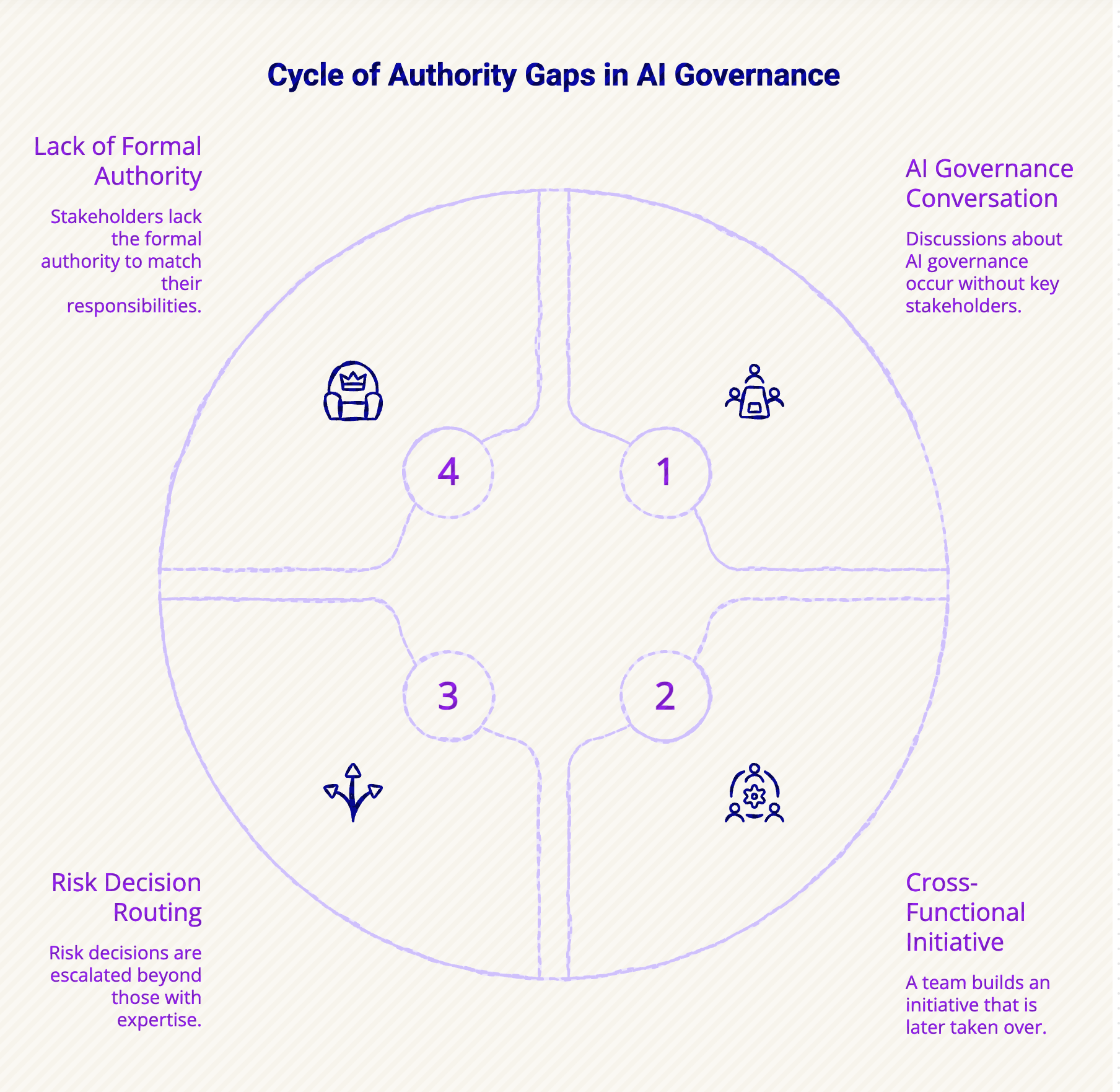
Cycle of Authority Gaps in AI Governance
AI doesn’t just change what executives need to know. It actively restructures who formally owns decisions inside an organization.
When an AI system makes a recommendation that used to require executive judgment, the question of who has the authority to accept, override, or govern that recommendation becomes urgent.
When an AI initiative crosses functional lines, the executive coordinating it needs formal decision rights to lead it — not just the credibility to be in the room.
When AI outcomes create risk, the executive accountable for those outcomes needs an explicit mandate to govern them.
Most organizations haven’t updated their authority architecture to answer any of those questions. The AI moved fast. The structure didn’t follow.
Which means the executives being asked to lead AI-driven work are often doing so on borrowed authority.
Influence that runs on relationships and reputation rather than formal mandate.
Accountability without the decision rights to match.
That’s not sustainable.
If this is the gap you’re carrying —
this is what Blumaverick was built to solve.
→ The authority gap doesn’t close on its own.
It closes by design.
→ If this resonated, Connect on LinkedIn • DM “AUTHORITY” to continue the conversation.
She works with a small number of executives at a time to resolve this — typically within ~90 days.
This is not executive coaching.
It is structural advisory for leaders whose scope has already outpaced what coaching can fix.