
AI Authority Gap™
Responsibility without authority — now accelerated by AI. ←
THE EXECUTIVE BRIEF
How AI-driven accountability is moving faster than organizational authority.
Its called:
AI Authority Gap.™
AI accountability lands on executives without the mandate to absorb it.
The brief explains why.
And why no one around you can fix it yet.


The Split
You own the number. Not the price.
Not the product. Not how the team sells it.
You own the AI outcome. Not the vendor. Not the data. Not the timeline.
You own the transformation. Not the budget. Not the people.All the accountability. None of the control.
That's not a challenge. That's exposure.
You know this if
Director to C-suite
Marketing • Sales • RevOps Product • GTM • Operations AI • Information • Risk • Data
Your accountability grew. Your title didn’t.
You’re making AI calls without the authority to back them.
You're carrying accountability you were never given authority for.
You’re tired in a way sleep doesn’t fix.
This isn't burnout. It's structural.
The pattern shows up three ways: responsibility lands, authority doesn't follow, executives leave.
67%
— of executives expect to be in a new role within three years — compensation the top reason.
Korn Ferry, 2025
60%
— of Chief Data & Analytics Officers now hold primary responsibility for their organization's AI strategy and operating model.
Gartner, 2025
70%
— of CIOs and CTOs are held accountable for AI systems they don't fully control.
IBM Institute for Business Value, 2026
Organizations are flattening.
Responsibility lands on the same people.
Those people are starting to leave — quietly, one at a time — toward firms that built the authority structure they were promised.
The gap has a clock.
The AI Authority Gap — the AI-accelerated form of accountability without control — holds about 18 months:
The Authority Lag™. You leave for the structure you were promised, or you're managed out for a performance problem that was never yours to fix.
Waiting is the losing move.
→ See what happens at the Authority Lag™.
AI didn't create the gap. It institutionalized one that was already there.
THE REFRAME
The convenient story:
AI is reshaping work, and executives are caught in the transition.
It's comfortable because the cause is external.The technology did it.
That's not the real story.
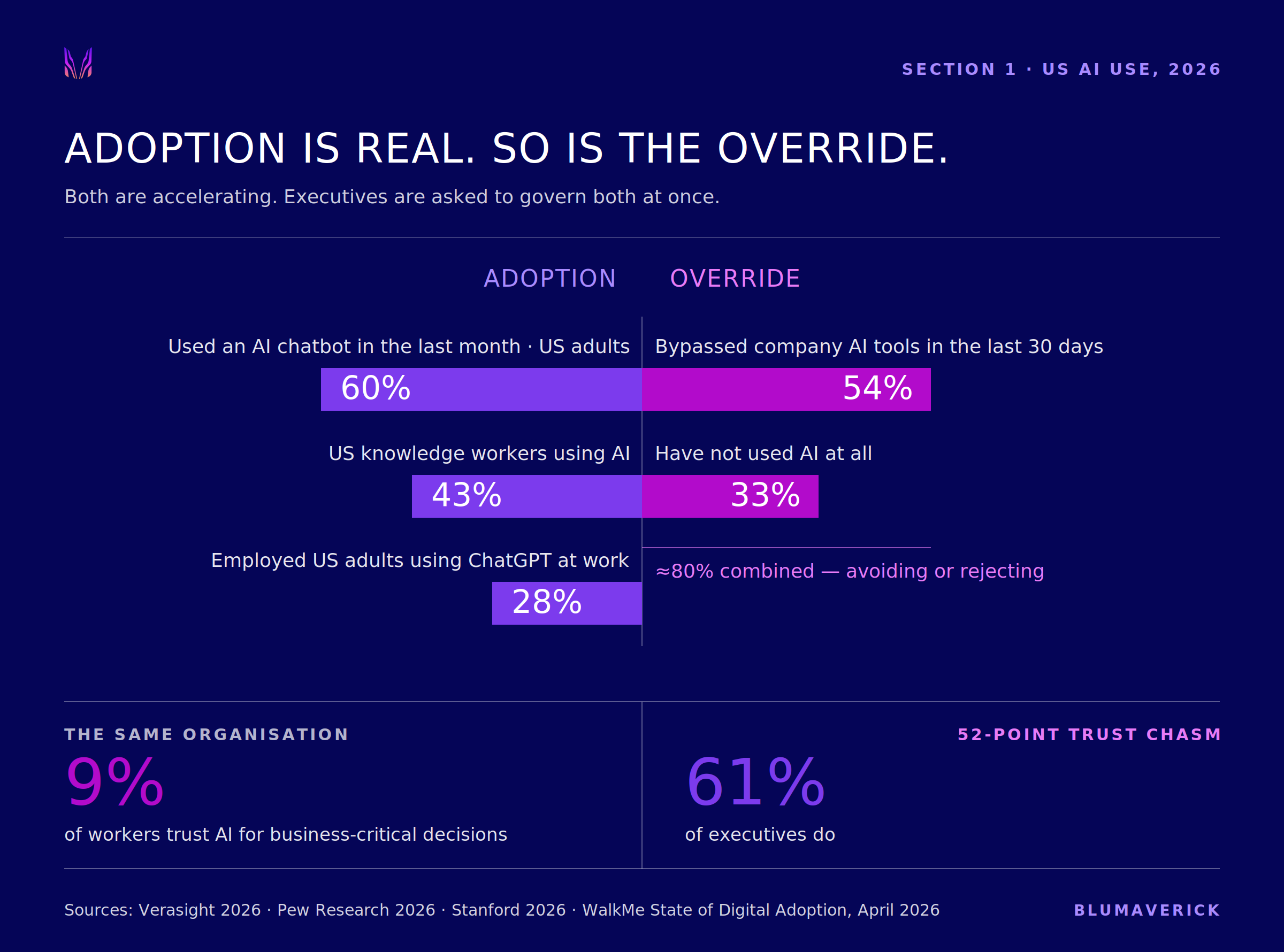
The numbers explain why AI has become an Executive Authority Gap issue.
They don't explain why accountability consistently lands on the executives with the least formal authority.

WHAT YOU'LL GET
Inside the brief.
Three pages.
For Executives
Carrying responsibility without the decision authority.
The AI Authority Gap™ Executive Brief
The Diagnosis — Three data points that prove this isn't a you problem.
The Reframe — The convenient story about AI, and what it hides: the executives carrying the gap aren't in a transition. They're in a permanent state.
Performance or Structure — How to tell a performance problem from a structure problem — and why no one around you can fix this one yet.
The Next Step — The hidden path to executive authority, and the one structural move that closes the gap. It changes when the structure changes, not when you perform harder.
Plus: McKinsey already named this→
Their research calls modern accountability "clouded" — decisions now spread to more people "without clarifying decision-making authority." Published, and largely ignored.
You can't out-work a structural problem, and you can't fix it in one conversation with your boss.
It closes when the structure changes — when the responsibility you already carry is converted into a named mandate: authority, title, and pay that match the work.
This doesn't close by performing harder.
That's the Executive Authority Method™ — the work I do, privately and one-to-one, with executives living this gap.
No sign-up required.
Executive Insights
Your company gave an AI system the ability to act.
Somebody still answers for what it does.
AI decision rights decide who that is — and what they can actually do about it.
Blumaverick calls the space between the two the AI Authority Gap™.
-
Three questions, answered in advance: what the system decides alone, what it checks with the human-in-the-loop first, and who can step in once it acts.
Most companies have written the first. Almost nobody has written the third — the only one that protects a named person.
-
Usually nobody. Not as a decision.
Ask who gave it scope and you get a history, not a name: a default setting, a feature switched on in an upgrade, a contract signed before the tool could do this.
That shrug is the finding.
-
Whoever was formally given that right. Nobody else.
Being accountable for the result does not come with it — which is how an executive ends up defending a decision they were never in a position to prevent.
-
Governance is about the system. Authority is about a person.
Governance says what the AI may do. Authority says who may stop it.
Two different documents. Only accountability has your name on it.
-
The executive whose number it moves.
Whether that same executive has any say over the algorithm producing the number almost never is.
-
Yes. At anytime.
Accountability follows the outcome. It does not check whether you had the authority to change it.
That is responsibility without authority at its sharpest — the AI Authority Gap™. It closes by formalizing responsibility, authority and compensation. That is the Executive Authority Method™.
-
The AI Authority Gap™ is what happens when AI accountability without authority lands on an executive. You own the AI outcome. Someone else owns the vendor decision, the data access, the deployment timeline, and the governance. But, when it goes wrong, it comes back to you.
It isn't a new problem. It's the Executive Authority Gap™ under new conditions — the same structural misalignment, now attached to decisions that carry regulatory and reputational exposure. AI didn't create the gap. It institutionalized one that was already there.
-
Take the three AI-enabled decisions with the most money attached.
For each one: who set its scope, who can halt it, whose name is on it when it goes wrong.
If the last name is yours and the middle one is not, that is your gap.