
Executive Advisory for Responsibility Without Authority
Your role was defined the day you were hired. It hasn't been updated since.
Responsibility kept accumulating. Authority never moved. Neither did title or comp.
That distance is the Executive Authority Gap.™ Blumaverick closes it.
Not Ready?
You're reading this because something happened.
A promotion cycle passed with vague feedback.
A lateral hire arrived above you.
A transformation mandate landed on your desk without the authority to execute it.
A performance review said exceptional and the org chart said wait.
It's Not Just You.
60% of C-suite executives are actively looking for new roles, driven by compensation misalignment and stalled mandates.
(Korn Ferry, 2025)
What Creates an Executive Authority Gap™
Responsibility is elastic; it flows to whoever can hold it.
Authority is fixed — it moves when someone deliberately grants it.
In a flat organization, the first happens constantly and the second almost never.
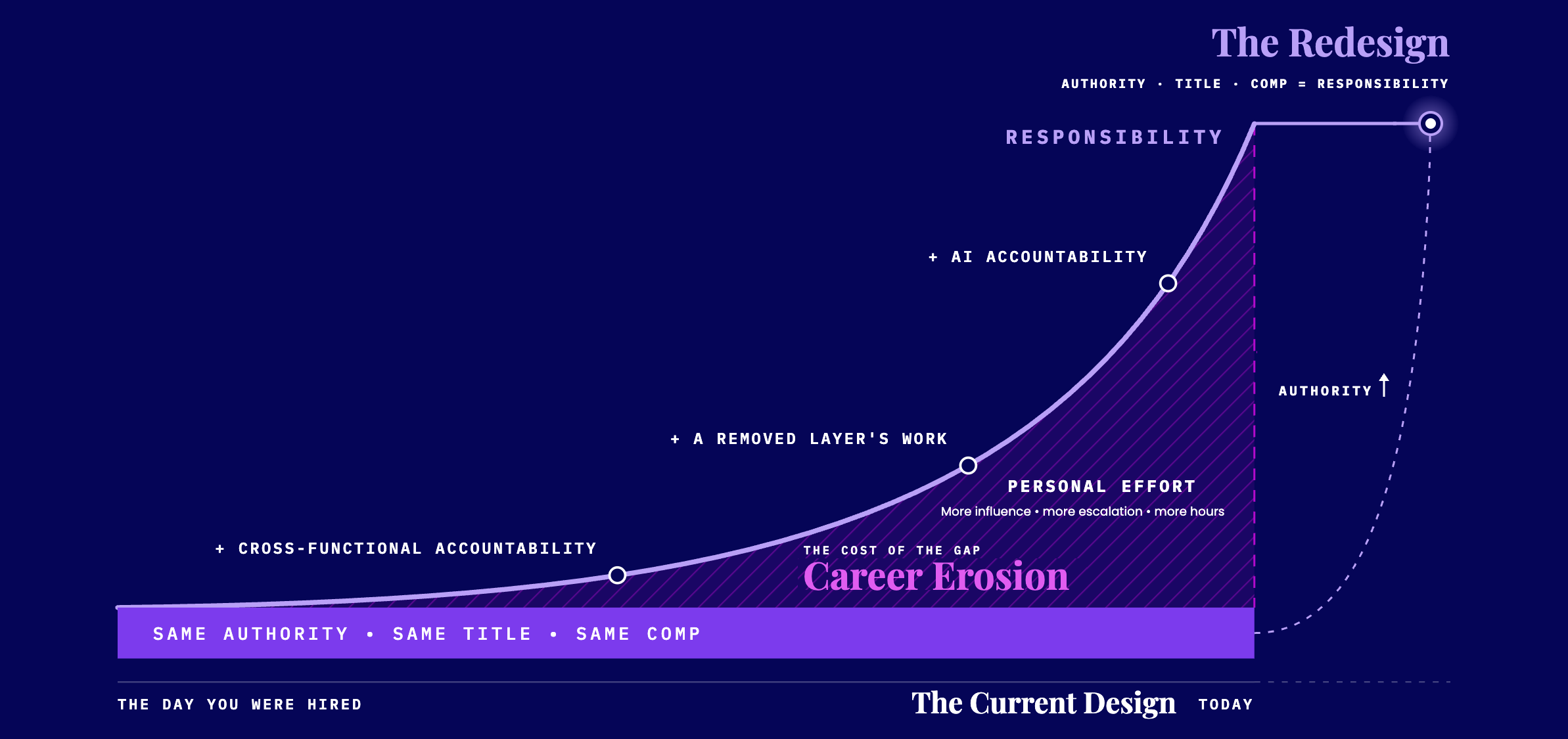
Expanding Responsibility
Each new project, reorganization or removed layer adds to the role. Authority stays tied to the version of the role you were hired into.
The gap takes shape in five ways
Unclear Decision Authority
In practice, unclear ownership slows execution and escalation. You can be overridden by peers who don't carry the outcome — and then you answer for the result.
Organizational Complexity
As organizations grow, reporting lines and cross-functional dependencies multiply. High performers become the connective tissue between teams.
Governance Friction
As organizations scale, decisions need more approvals. Accountability gets harder to trace, and the pace of the business slows.
Incumbent Resistance
Authority is finite. Granting it to you means someone else holds less. The individuals most capable of expanding your mandate often stand to lose the most. This is why the gap remains, even when everyone can clearly see it.
What Actually Changes
The responsibility expanded. Nothing else did.
Structural Alignment
Your title, mandate, and responsibilities finally describe the same job.
Formal Authority
Decision rights, governance, and reporting align with the outcomes you're expected to own.
Executive Recognition
Your compensation and executive standing reflect the responsibility you're already carrying.
The Executive Authority Method™
The Executive Authority Method™ identifies where executive responsibility has outgrown authority in organizational structures.
It provides a structured path to realignment of responsiblity + authority + compensation through the Executive Authority Audit™ and private advisory.
Executive Authority Audit™
A private diagnostic that shows where your responsibility
has outgrown your authority—and what to do about it.

Is Executive Advisory Right for You?
If responsibility has exceeded your authority, the org
—not your performance—needs diagnosis.
The Practice
Executive Advisory Overview
Executive Insights
-
— The distinction, stated plainly.
-
Executive coaching addresses individual behavior, mindset, and interpersonal dynamics. The authority gap is a structural problem — rooted in how the organization has designed (or failed to design) its systems of decision rights, mandate, and authority. Structural problems require structural solutions. That is what Blumaverick provides.
-
Blumaverick works with executives across enterprise technology, emerging technology startups, private equity-backed growth companies, and global financial services. The structural authority gap is not industry-specific — it is a condition that high-performing organizations frequently create and rarely diagnose.
-
— Programs develop the individual; Blumaverick redesigns the structure around them.
-
Usually, yes. Executive advisory at this level is most often employer-sponsored — funded through an existing L&D allocation, a professional development line, or a CHRO budget already used for senior engagements. Many executives don't ask because they assume advisory sits outside what the organization funds. It typically doesn't.
The framing that works is structural, not personal. Accountability without control is an operational hazard for the company, not just a frustration for you — it slows execution and it costs them people. That's a retention conversation, and it comes out of a different budget than development does.
Blumaverick can provide an overview document for that conversation.
-
— the Audit™ is one hour.
-
Not through coaching, and not by working harder. Responsibility without authority is a structural condition — it lives in decision rights, mandate definition, and how the organization has designed the role. Fixing it means redesigning those systems, not developing the person inside them.