
You're Doing the Work of Two Roles Now. AI Didn't Cause That.
VPs and Directors are absorbing two missing layers of work — "AI replaced jobs" is the cover story.
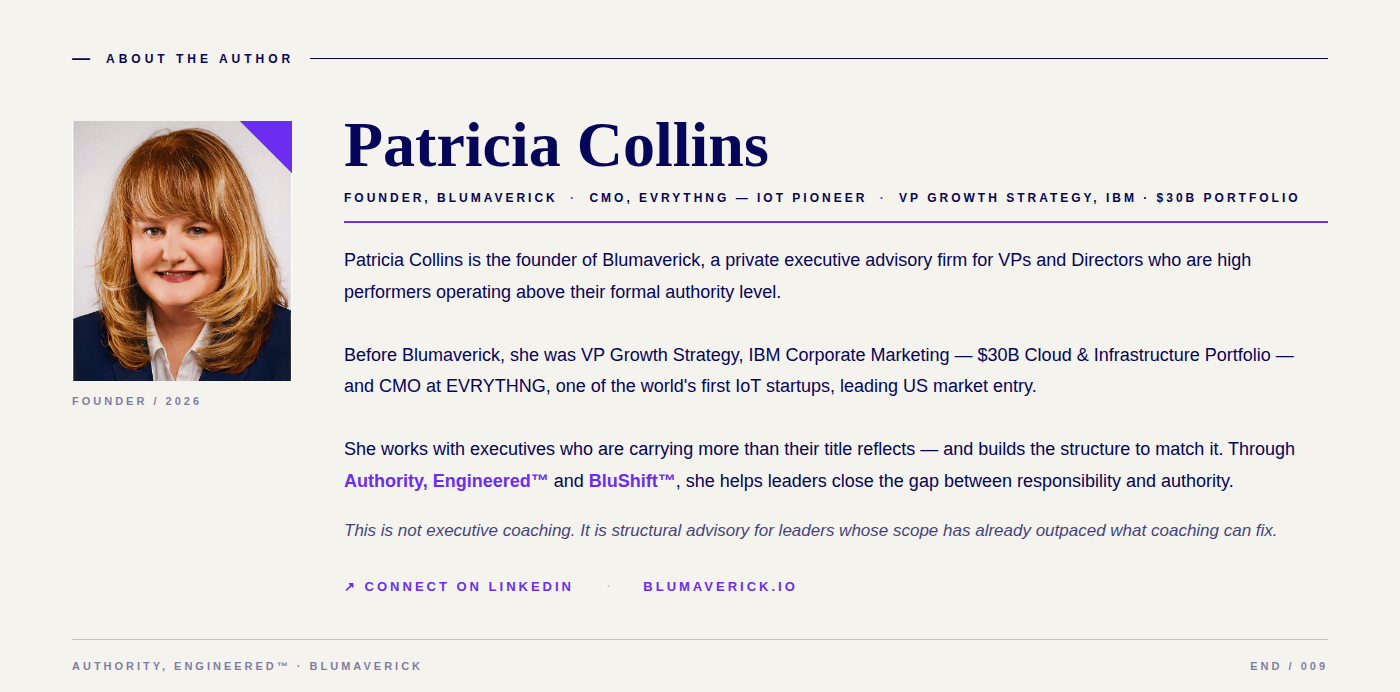
By Patricia Collins · Founder, Blumaverick ·
CMO at EVRYTHNG (pioneering IoT startup) · former VP Growth Strategy, IBM ($30B portfolio)
It was a Tuesday afternoon.
I was staring at my half finished cup of Keurig Dark Roast that I made at 8am.
When the day was just beginning and anything was possible.
Now it had the consistency of a pot of coffee that had been sitting all day on the Bunn burner.
That was my fifth meeting.
A strategy review that technically belonged to my peer’s function — except his role had been eliminated in the spring restructure and “absorbed into the broader team.”
Which turned out to mean absorbed into me.
Before the meeting I’d needed one thing. The company holiday calendar.
I typed into the new AI assistant they’d rolled out company-wide.
“Where can I get a copy of the yearly company holiday calendar?”
It didn’t understand the question.
I sat there staring at the screen.
This was the tool that was replacing jobs.
This was the technology making entry-level work obsolete.
This was the AI transformation they’d announced to the board.
And it couldn’t find the holiday calendar.
Meanwhile I was in my fifth meeting —
doing the work of three roles — because the people who used to do it had been offshored, restructured, and replaced by a chatbot that couldn’t answer a basic question.
That wasn’t an AI story.
That was a margin story.
And I was the one paying for it.
What’s Actually Happening to High Performers in 2026
Here is the pattern showing up in nearly every mid-to-large organization right now.
A junior or entry-level role goes unfilled. The work routes upward. A peer-level role gets eliminated in a “flatten the structure” restructure.
The work routes upward again.
The remaining VP or Director — usually the most reliable one — absorbs both gaps without a title change, a budget change, or a formal mandate change.
Leadership describes the result as “doing more with less.”
The earnings call describes it as “AI-driven efficiency.”
Both descriptions are convenient. Neither is accurate.
What’s actually happening is that capable executives in the middle of the org are absorbing the structural cost of decisions made above them —
and the AI conversation is providing the cleanest narrative cover for those decisions in a decade.
“The AI story is true enough to be useful — and convenient enough to obscure what’s actually happening to you.”

Cover Story: Why “AI” Is the Convenient Explanation
"AI is making entry-level work cheaper" reads cleanly on an earnings call. It reads cleanly in a board deck. It reads cleanly in the press release explaining a 12% workforce reduction.
What does not read cleanly:
“We removed the development layer to widen margins, pushed the work up two levels to people who don’t have the authority to push back, and labeled the result an AI transformation.”
Both descriptions can describe the same restructure. Only one creates shareholder value when you say it out loud. So one gets said constantly. The other gets absorbed by the people doing the work.
The roles being offshored weren’t eliminated because AI made them redundant. They were eliminated because offshoring them was cheaper — and AI gave leadership a story that made the choice sound inevitable rather than deliberate.
If you are a VP or Director feeling the squeeze, the diagnostic question is not “how do I respond to AI?”
The diagnostic question is: what choice did my organization actually make — and who is bearing the cost of it?
The answer is usually you.
The Mechanism: Margin Came First. AI Came Second.
The development layer in most organizations was already being thinned before AI was a headline. Three patterns were already in motion by 2023:
Hiring freezes on entry-level and early-career roles
The 2022–2024 corporate playbook — “do more with less,” “operate lean,” “protect margin” — quietly shifted hiring away from junior development roles. Those roles weren’t replaced when people left. The work didn’t disappear. It moved up.
Flatter org structures sold as “agility”
The shift from seven layers to four layers was branded as a speed and accountability story. Structurally, it eliminated the peer-level cushion that absorbed cross-functional friction. That friction didn’t disappear either. It moved up.
Promotion deceleration without scope deceleration
Performance still expanded. Title didn’t. The gap between what someone was doing and what they were formally recognized for kept widening. The organization captured the output. It declined to upgrade the architecture that was supposed to support it.
AI showed up after all three of these were already true. AI did not cause them. AI gave leadership a story that made all three look like an inevitability rather than a choice.
The Cost: What Absorbing Two Layers Actually Does to You
Here is the part the AI-jobs essays are not writing about.
When a VP or Director absorbs two missing layers — junior below, peer beside — what happens structurally is not a workload problem. It is an authority architecture failure.
You become the de facto decision absorber
The junior-level decisions that used to get filtered before reaching you now arrive directly. The peer-level decisions that used to be debated cross-functionally now route to you because you’re the only one with context. This is decision-boundary compression — and it compounds every quarter the structure stays unchanged.
Your scope expands silently
No reorg announcement. No new title. No new budget authority. The org chart still reads what it read in 2023. What you are actually running is two roles wider and one role deeper. This is the Executive Authority Gap™ — the structural condition where a leader’s real scope exceeds their formal mandate, decision rights, and organizational recognition.
You become structurally invisible
Not because you’re underperforming — the opposite. Because you’re absorbing the gap so reliably that the gap stops surfacing to leadership. The cost of the structural choice gets paid quietly inside your calendar, your weekends, and your nervous system.
You get described in language that hasn’t caught up
In the all-hands, you’re still introduced as Director of [function]. In the board materials, you’re still listed under your old scope. Your work is at a different altitude than your perception. We call this Perception Lag — and it is the single biggest reason high performers in this position get passed over while less capable peers get promoted.
“By the time it shows up on the P&L, the executive who was carrying it is usually gone.”
What This Actually Is — And What Closes It
What you are experiencing is not an AI problem. It is not a performance problem. It is not a workload problem.
It is an Executive Authority Architecture™ problem.
Executive Authority Architecture™ is the deliberate structural design of scope, authority, and organizational recognition around a leader’s actual scope.
When that architecture lags two layers behind the work, no amount of performance closes the gap. No amount of executive presence training closes it.
No amount of “influence without authority” closes it.
The architecture has to be redesigned.
Three structural moves close the gap:
1. Name the gap explicitly
Map the work you’re now absorbing that didn’t exist in your formal mandate 18 months ago. Identify which decisions belong to a role one level above you, and which belong to a role one level below. The first audit is for you. The second is for the conversation with your manager.
2. Architect decision boundaries deliberately
Decide which absorbed decisions you will continue to own — at executive scope, with executive authority — and which you will route back to where they structurally belong. This is not a delegation conversation. It is a Decision Boundary Design conversation.
3. Reposition the narrative
The organization is describing your role in language calibrated to 2023. Your scope is calibrated to 2026. The gap between those two descriptions is the perception lag. Closing it requires deliberate structural narrative repositioning — not more visibility, not more performance, not a louder voice. A redesigned story.
This is the work the BluShift™ Authority Assessment maps. It diagnoses where your scope has outrun your structure — and gives you the language to have the conversation with leadership in terms they can act on.
Key Takeaway:
The AI story is true enough to be useful —
and convenient enough to obscure what’s actually happening to you.
You are not experiencing an AI disruption.
You are experiencing a structural choice your organization made for margin reasons.
The gap it created has a structural fix.
But it won’t close on its own.
The stress of performing at this level — without the authority to match it — takes a toll.
On your body.
On your focus.
On your finances.
On the life outside the office.
This is the price of being overlooked.
DM me AUTHORITY. 15 minutes.
No pitch. Just clarity on what's actually going on — and how to change the pattern.
──────────────────────
Sources
Gartner — “Gartner Unveils Top Predictions for IT Organizations and Users in 2025 and Beyond” (October 2024)
McKinsey — “Untangling Your Organization’s Decision Making”
Capterra — “Middle Manager Burnout is High”
https://www.capterra.com/resources/middle-manager-burnout-strategies/
