
The Quiet Derailment: How High-Performing VPs, Directors, and C-Suite Leaders Get Sidetracked
How High-Performing VPs, Directors, and C-Suite Leaders Get Sidetracked — and What It Actually Costs
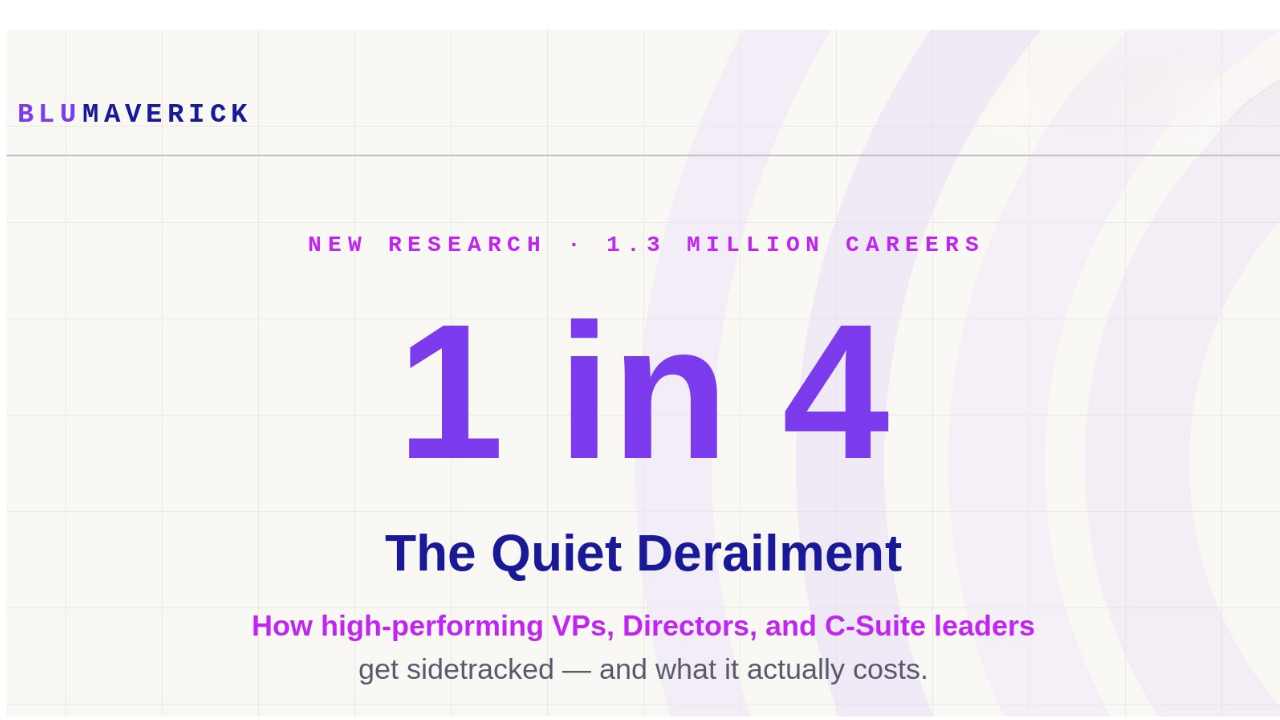
Consider a number: 1 in 4.
That is the share of mid-career professionals who have gone five or more years without a promotion or meaningful raise — still employed, still delivering, but structurally stalled. This isn't a rounding error or some outlier group: it's one in four, and it climbs the ladder too. Even executives aren't exempt — though at the top, the stall tends to hit a breaking point around the 18-month mark.
This is the central finding of Sidetracked: The Hidden Crisis in Mid-Career Mobility, published June 2, 2026, by the NYU School of Professional Studies and the Burning Glass Institute, drawing on 25 years of career histories across 1.3 million professionals. The researchers named it precisely: not unemployment, but a loss of momentum inside employment.
If you recognize yourself in that number — or suspect you're close to it — this is worth your full attention. Here's the part that should stop every senior leader cold: seniority is not the escape hatch.
The Hidden Crisis
This Is Not a Performance Problem
The instinct is to look inward. To wonder what you missed, what you didn’t do, who you didn’t impress. That instinct is understandable, and it is wrong.
The Sidetracked research is unambiguous: mid-career stall is a structural phenomenon, not an individual failure. Organizations have flattened. Internal mobility pathways have narrowed. The architecture that once moved high performers upward — through visible roles, sequenced advancement, and systematic exposure to decision-makers — has quietly contracted.
What remained constant is output. Executives in stall are still delivering. The problem is not performance. The problem is that performance is no longer automatically converting into advancement.
The instinct is to assume stall is a problem for people earlier in the climb — and that once you reach VP, Director, or the C-suite, you've cleared it. A separate body of research, focused squarely on the executive level, says otherwise. The same forces that stall a mid-career professional don't disappear at the top of the org chart. They get quieter, harder to name, and far more expensive.
If you want proof that this isn't about being good enough, look at the very top of the org chart.
In 2015, Tom Staggs was the second most powerful executive at The Walt Disney Company. Twenty-six years into his career, he had served as CFO, run the theme-parks division where profits doubled under his leadership, and had been elevated to COO and widely viewed as Bob Iger's successor.
He never became CEO.
There was no performance problem. Analysts saw no indication Disney was dissatisfied with his work. What was missing was something entirely different: assurance that the scope he was already carrying would convert into the authority and title that matched it.
When that assurance never came, he left.
The pattern repeated four years later when Kevin Mayer — the executive who built Disney+ and led the $71 billion Fox acquisition — was passed over for the CEO role and departed as well.
Staggs and Mayer are not anecdotes. They are data points in a measured pattern. Stanford Graduate School of Business researchers studied every CEO succession at the 100 largest U.S. corporations over a decade — 121 transitions — and tracked what happened to the 100 senior executives publicly identified as passed over. The result: 74% left the company. And of those who left, fewer than a third — 30% — went on to become CEO somewhere else. The rest stepped down a level, moved into advisory or investment roles, or retired. Read that again: when the title doesn't follow the scope, three out of four senior executives walk — and most of them never get the bigger chair.
The mechanism behind that exodus has been measured too. Research published in The Accounting Review tracking executives passed over in CEO tournaments found that after the missed promotion, their compensation saw only limited adjustment — the organization did not close the gap — while their future promotion prospects measurably declined. And the executives most likely to leave were precisely the ones who had been the strongest candidates. The architecture freezes around the leader who came in second. Waiting does not thaw it.
Neither Staggs nor Mayer worked harder inside a structure that had stopped advancing them. They read the signal and made a structural move: together they built Candle Media into a major content company, backed by Blackstone. They changed the structure.
And it isn't a one-company story, or a new one. When Jack Welch staged his famous three-way race to succeed himself at GE, the two runners-up were gone within months — one of them Bob Nardelli, the man Welch called the best operating executive who ever worked for him. Three executives that good, one chair. Being good enough was never the deciding variable.
That is the executive version of the Sidetracked finding. Most VPs, Directors, and C-suite leaders who hit it don't have a public succession drama to make it legible. It just shows up quietly — as scope that keeps growing while the title sits still.
Neither executive lacked capability. Their experience illustrates a larger reality: at senior levels, advancement is determined less by output and more by positioning, mandate, and visibility inside the decision-making structure. When the structure stops moving you forward, additional performance rarely changes the outcome.
Most executives who experience stall never have a public succession battle that makes the issue obvious. It simply appears as responsibilities that keep growing while titles, authority, and advancement remain unchanged.
Not sure if you’re in the window? Blumaverick’s Authority Audit maps where your gap is widest and what to move first — so you can scale yourself, not just your output. Send a message with the word AUDIT and I’ll send it to you directly.
Scope Without Title Is Now a Strategy — Theirs, Not Yours
If "operating above your title" feels like your personal situation, here is the uncomfortable reframe: it is also a documented compensation practice.
Compensation consultancy Pearl Meyer found that 13% of employers now use job titles to reward employees when funds are limited — up from 8% in 2018. More striking: 37% of organizations actively use titles to retain key people, up from 27% in 2018, and a third now use titles in place of money to reward current employees — a 74% increase over pre-pandemic levels. The practice has a name in the HR literature: the dry promotion. More scope, more accountability, a bigger mandate — and a paycheck that doesn't move.
At the executive level, the dry promotion usually arrives without even the title. The reorg adds two functions to your remit. The departing peer's team folds into yours. The board presentation becomes yours to deliver. The work is C-suite. The recognition isn't.
Understand what this means: the gap between your scope and your standing is not an oversight the organization will eventually notice and correct. For a growing share of organizations, it is the plan. Recognition deferred is compensation saved.
The Financial Penalty Is Larger Than You Think
There is a temptation to treat stall as a career inconvenience — a plateau, not a crisis. The data does not support that framing.
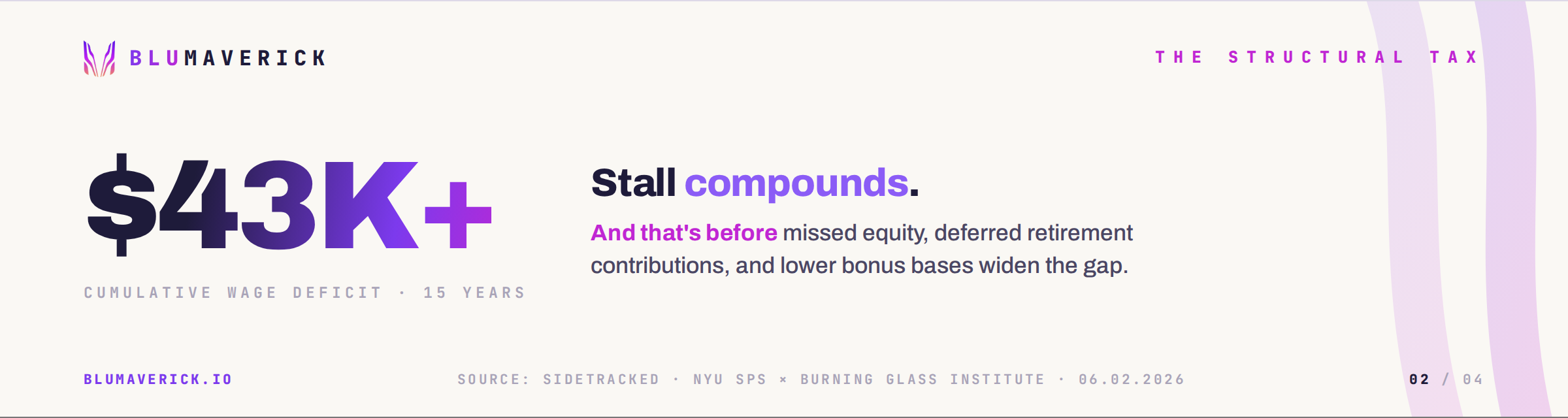
The Sidetracked researchers put a concrete number on it: for the average stalled software developer, the cumulative wage deficit exceeds $43,000 over 15 years compared with peers who keep advancing. Compound that across total compensation: missed equity, deferred retirement contributions, lower bonus bases, and the compounding effect of raises never received.
Now run the same mechanism at the executive level — with current numbers.
Mercer's compensation surveys show what an annual cycle is actually worth right now: merit increases averaged 3.2% in 2025, with total increases of 3.5%, and 2026 budgets are planned flat at the same levels — barely ahead of inflation. A promotion, by contrast, carried an average raise of 8.5%. And employers expected to promote only about 10% of their workforce. ADP's analysis of 50 million workers puts the managerial promotion rate at roughly 6.5% a year.
So the executive denied the step-up loses five-plus points of compensation growth per year against the promoted peer — while the merit raise they do receive roughly tracks inflation. That is before the part that makes the executive penalty a multiple of the mid-career one: structure. At the VP, Director, and C-suite level, base salary is the smallest lever. Bonus targets and long-term incentive grants are set as percentages and multiples of level — and research on managerial pay finds that career setbacks hit variable compensation hardest, showing up more strongly in subsequent bonus payments than in fixed salary. Every missed step-up freezes the base, the bonus target, the equity multiple, and the deferred contributions calculated on all of them — and every future increase compounds off the frozen number.
The percentage of the stall looks similar at the top. The dollar value of it is an order of magnitude larger.
And organizations are noticing the downstream damage. According to the Payscale 2025 Compensation Best Practices Report, 31% of organizations cite perception of unfair pay as a primary reason they are losing talent — up from 21% the prior year. The gap between what high performers are worth and what they are being paid is becoming impossible to obscure.
This is not a personal setback. It is a structural tax on expertise.
Stall Compounds
The Structural Tax
The Real Variable: Authority Architecture
If performance isn’t the problem, what is?
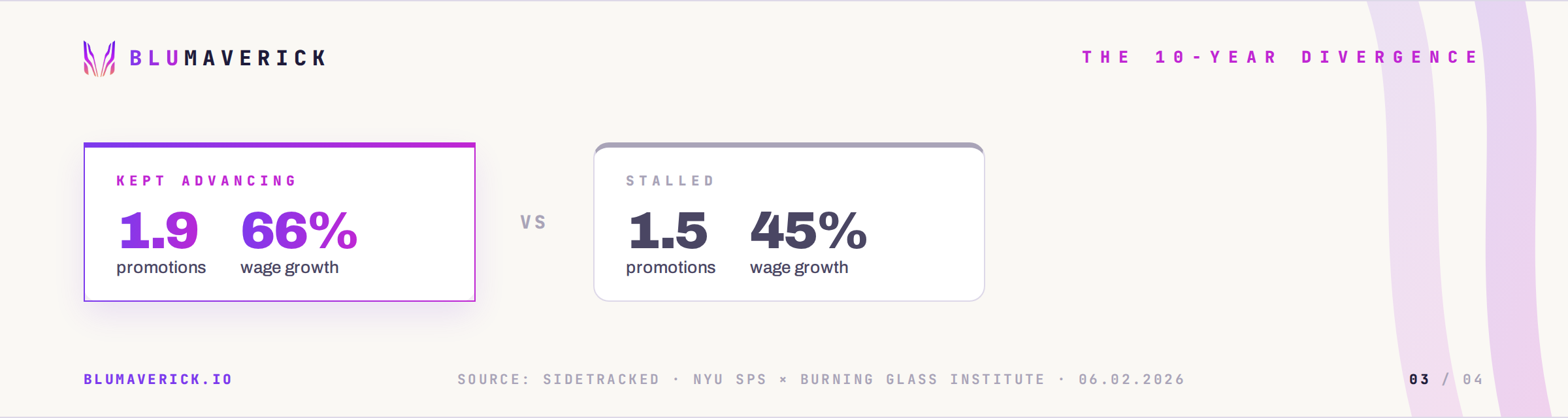
The research points to visibility and momentum. Those who avoid stall average 1.9 promotions and 66% wage growth at the ten-year mark. Those who stall average 1.5 promotions and 45% wage growth at the same point. The divergence is not dramatic — it is incremental, structural, and self-reinforcing.
What separates the two trajectories is not talent. It is how that talent is positioned, perceived, and legible to the people making advancement decisions.
The structural environment is also changing beneath senior leaders.
And the ground is actively shifting under senior leaders. As organizations flatten, scope is consolidating onto fewer people: the average manager's direct reports rose from 10.9 in 2024 to 12.1 in 2025 (Gallup), 41% of professionals say their company stripped out management layers in 2024–25 (Korn Ferry), and middle managers absorbed 29% of all layoffs in 2024. Gartner expects one in five organizations to use AI to flatten further, cutting more than half of middle-management roles by 2026. Fewer layers means more scope and fewer rungs — and as organizational-design analysts note, flattening without redesigning progression creates a promotion bottleneck that quietly pushes high performers out. The work moves up. The titles don't follow.
There is a mirror image of this problem worth naming, because it proves the point. Transition research shows that even high performers who do get promoted fail at striking rates in their first year — not from lack of talent, but because no one builds the architecture around the move. Stall before the title, derailment after it: same root cause. The structure, not the person.
The result is predictable: more scope is being pushed onto fewer people while the number of advancement opportunities shrinks.
The work moves up.
The titles don't always follow.
Blumaverick defines this as the Executive Authority Gap™ — the distance between how much authority a leader has earned and how much institutional authority they actually hold. The gap is real, it is measurable, and crucially, it is closeable. But it does not close on its own, and it does not close through harder work alone. It closes when executive presence, positioning, and organizational visibility are built deliberately — with the same strategic intentionality you'd apply to any other business problem.
The 10 Year Divergence
The Forward Obligation
The Sidetracked report offers something rare in workforce research: precision about when intervention becomes possible. The researchers are explicit — stall is not a sudden rupture. It is a slow-moving pattern that becomes visible well before it becomes entrenched.
The researchers themselves are clear: “The stall isn’t one singular event — it’s a bunch of small structural warning signs that show up much earlier than the event happens.”
In advisory practice, the pattern is consistent. The signal begins around the 12-month mark — subtle enough to rationalize as an organizational cycle or budget constraint. By 18 months, it has reached its inflection point: the deceleration is no longer ambiguous, but it still hasn’t been named. That window between recognition and response is where trajectory is decided.
In advisory practice, the pattern is consistent. The signal begins around the 12-month mark — subtle enough to rationalize as an organizational cycle or budget constraint. By 18 months, it has reached its inflection point: the deceleration is no longer ambiguous, but it still hasn't been named. Blumaverick calls this the 18-Month Breaking Point™ — the window between recognition and response, where trajectory is quietly decided. Act inside it, and the stall is reversible. Miss it, and the gap begins to harden.
What the early pattern looks like:
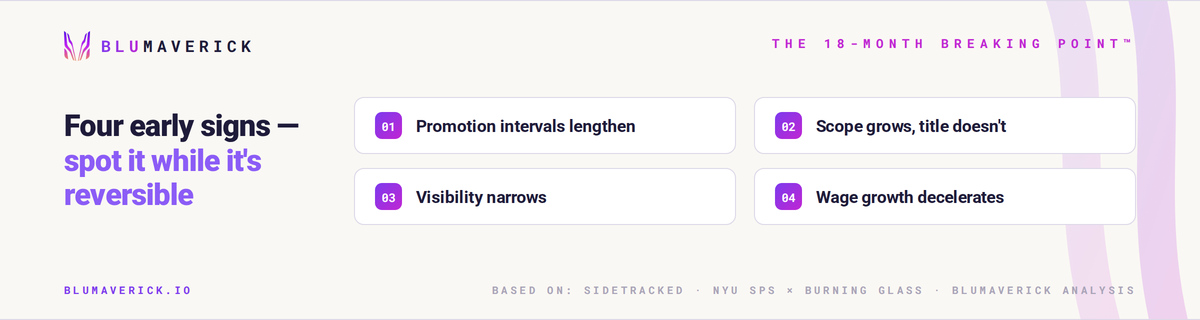
• Promotion intervals lengthen. What used to move in 18-month cycles starts stretching to three years, then longer — with no structural explanation and no clear criteria for what would change it.
• Scope expands, title doesn’t. Responsibilities grow — new teams, larger mandates, cross-functional accountability — but the organizational chart doesn’t move. The work is C-suite. The recognition isn’t.
This pattern is intensifying fastest where AI is concerned — executives now accountable for AI outcomes they have no authority to govern — the same gap, sharpened by a technology moving faster than any org chart.
• Visibility narrows. Access to key decision-makers becomes mediated. The executive is doing the work but is no longer in the rooms where advancement decisions are made.
• Wage growth decelerates. Annual increases track inflation, not contribution. The raise reflects tenure, not trajectory.
By the ten-year career mark, those who ultimately stall have already fallen behind — averaging just 1.5 promotions and 45% wage growth compared to 1.9 promotions and 66% growth among peers who continue advancing. The divergence began earlier. It just wasn’t named.
For executives at the VP, Director, or C-suite level who recognize this pattern, the question is not whether the problem exists. The data settled that. The question is whether the response will be individual and improvisational — or structural and deliberate.
High performers who have spent years building organizational value deserve a strategy equal to what they have built.
The challenge is not personal reinvention.
It is architectural correction.
The executives who navigate stall successfully rarely become different people. They become more intentional about how authority is accumulated, communicated, and recognized inside the systems where advancement decisions are made.
The goal is not simply to do more work. It is to ensure the work, influence, and authority remain aligned.
The framework exists. The path is not personal reinvention — it is architectural correction.
For executives ready to close the gap, two moves matter most:
Map your gap. Take the 60-second Authority Gap Checklist now for a fast read on where your scope has outrun your title — and you're first in for BluShift™, which maps the patterns in your seat and the levers to pull, when it opens end of June. blumaverick.io/blushift
→ Request a Private Preliminary Briefing. For executives whose authority gap has become a structural risk — the AI exposure is now material and the structural levers aren't yet in your hands — I offer a confidential 30-minute briefing before any discussion of engagement. Request it through the Authority Audit page. I respond personally.
Or get Sideways in your inbox for the next one.

Patricia Collins • Founder. Blumaverick
Power moves that skip the org chart.
Continue exploring executive authority, structural diagnosis, and the moves that create momentum beyond formal title.
View more Sideways articles →