
RevOps Owns the AI Stack. The Title Hasn't Updated.
If you're a VP of RevOps accountable for the GTM AI stack with no formal AI governance authority — this essay is for you.
─────────────────────────────────────────
You're the VP of Revenue Operations at a $200M ARR B2B SaaS company. Last quarter, you finalized the migration to a new revenue intelligence platform. You evaluated the AI features against three vendors. You wrote the integration spec. You approved the data flow into Clari, the AI handoff into Outreach, the Gong call-summarization model the SDRs are now running outbound through. The CRO presented the consolidated stack at the board meeting last Tuesday. He used the word "we" eleven times.
Then this week, the AI-generated forecast missed by 14%. The board call is in six days. The CRO has asked you for a "quick analysis of what went wrong with the model."
You are the one person in the building who can actually do that analysis. You are also the person who will be cited internally as "the ops team's call" if the analysis is uncomfortable. The CRO will present the explanation. The board will hear it from him.
This is the pattern. If you've felt it before, you're not imagining it.
What you're actually living
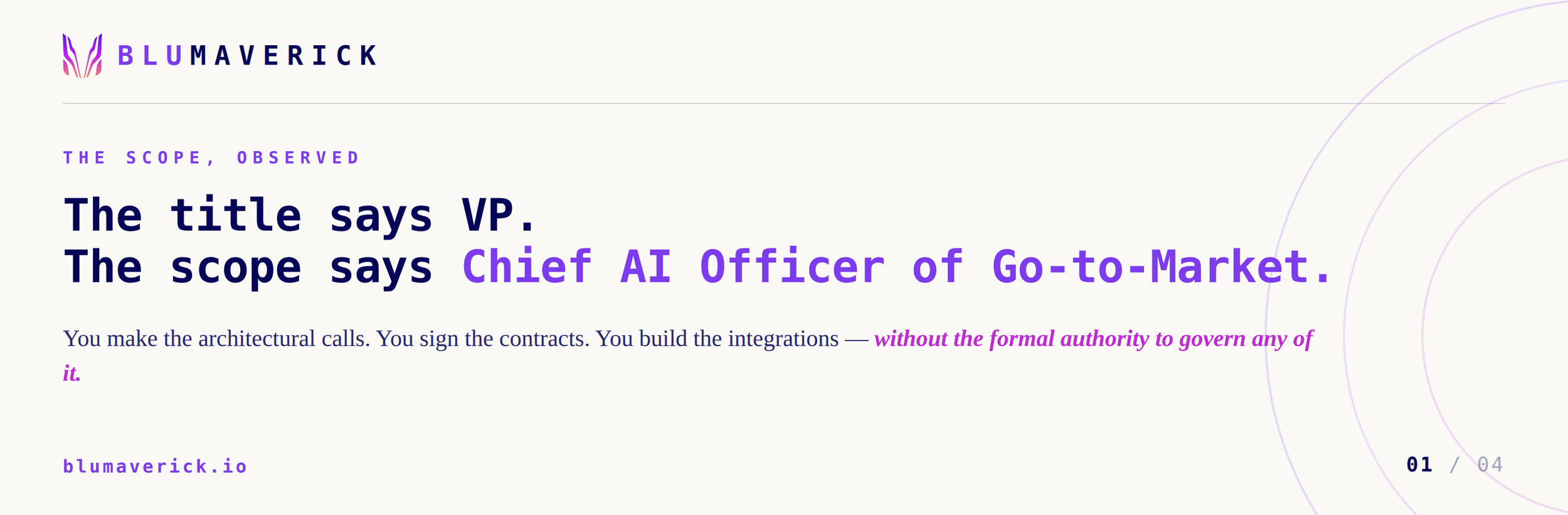
The VP of RevOps role has changed structurally in the past three years. Five years ago, you owned reporting, dashboards, territory planning, and quota mechanics. Today, you own the entire GTM AI stack — every AI tool that touches a revenue motion. Gong, Clari, 6sense, Outreach, Common Room, every new agent, every ChatGPT Enterprise rollout into marketing or sales enablement. You make the architectural calls. You sign the contracts. You build the integrations.
You have not been given formal authority over what other functions deploy on the AI side. You report to a CRO who can't audit your choices — the technical depth required is no longer reachable for someone whose day job is hitting the number. And you carry the cumulative behavior of every AI tool in the GTM stack — the bias in the model, the call-summary accuracy, the forecast drift, the data exposure — as a named accountability.
The title says VP. The scope says Chief AI Officer of Go-to-Market.
This is one of the patterns we map at Blumaverick. You operate at executive level. The org still treats you like execution layer. Your self-concept and the org's perception of you are out of sync.
Layered on top: you're accountable for AI outcomes you were never given the formal authority to govern. There's a name for that — the AI Authority Gap™(link this term to /ai-authority-gap).
Why this is structurally worse than the version your peers describe
There's a story RevOps tells itself, and tells in Pavilion threads, about "scope creep." That framing under-describes the situation, because it makes it sound like a workload problem. Workload problems get solved by hiring, by tooling, by re-prioritization.
This is not a workload problem. It is a structural authority problem.
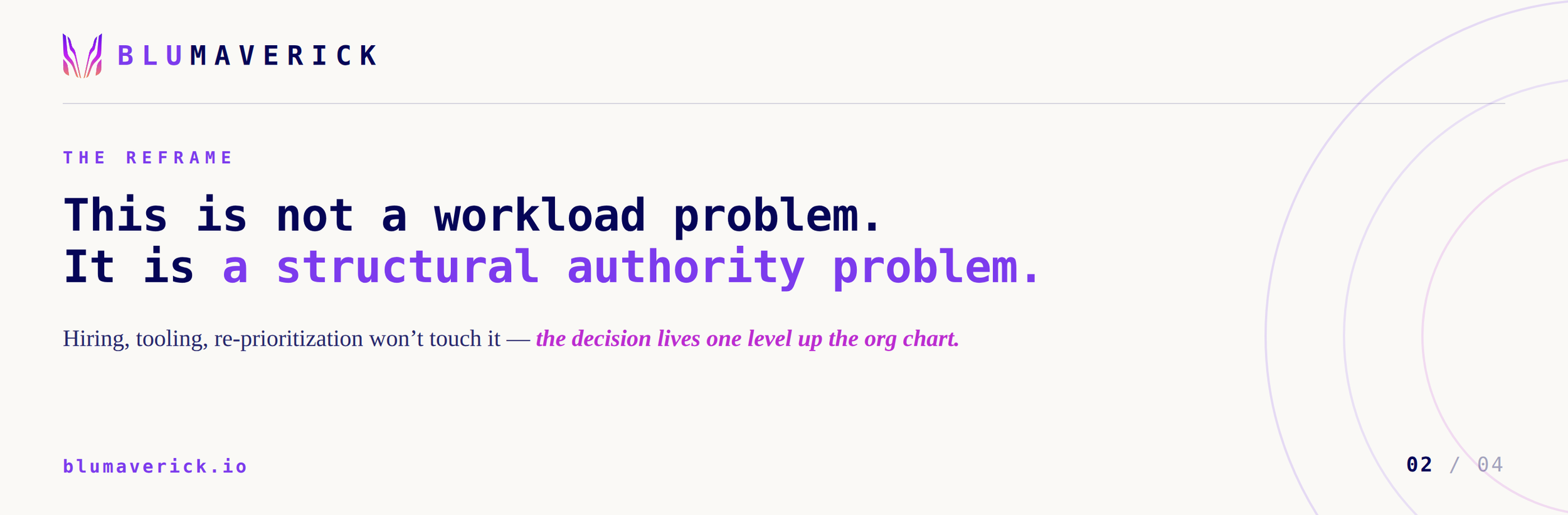
The hiring you would do, the tools you would standardize, the trade-offs you would make if you were authorized to make them — those decisions live one level up the org chart, with a CRO who hasn't been technical enough to make them in two product generations.
You absorb them anyway. The cost is borne by you, in the form of hours, blame, and a personal brand that's still "the operations leader" rather than "the architect of revenue infrastructure."
The structural exposure is the AI version. Your CRO will present an AI-driven forecast next quarter that you produced. If it lands, the credit will land on his slide. If it misses, the analysis of why it missed will be requested from you — and the answer will live downstream of your name, even when the actual root cause is a vendor decision he made or a data pipeline IT controls. You are the inheritor of every model behavior in the stack.
The three structural moves
If this essay names your situation, three moves are available.
One: name the role you're already carrying. Not in resentment — in structural observation. The accountabilities that should sit at the CRO level but route to you are not a feeling; they're a list, and most VPs of RevOps have never written it down. Until it's named, it can't be moved.
Two: get one decision formalized. Not all of them — one. The most consequential authority you exercise informally, made formal. For most VPs of RevOps that's AI vendor selection and removal: you already make the call, but nothing says so. The gap between exercising authority and holding it is the whole game, and it closes one decision at a time.
Three: change what the introduction reads from. You're still introduced as "the ops person" — a year-one label running in your third year. The instinct is to fix the description. That's the move that doesn't hold, because perception is downstream of structure. People introduce you from what's written down — and what's written still describes the old role. Change that, and the introduction updates itself. Your own sense of the role catches up last, not first — the reverse of how the coaching market sells it.
Where this goes if you don't close the gap
The default trajectory for a VP of RevOps in the AI Authority Gap is one of three exits before an 18 month Breaking Point: burnout, an internal promotion that "solves" the title problem but leaves the structural problem identical, or quitting for a CRO role at a smaller company.
None of the three is bad. Two of them are expensive.
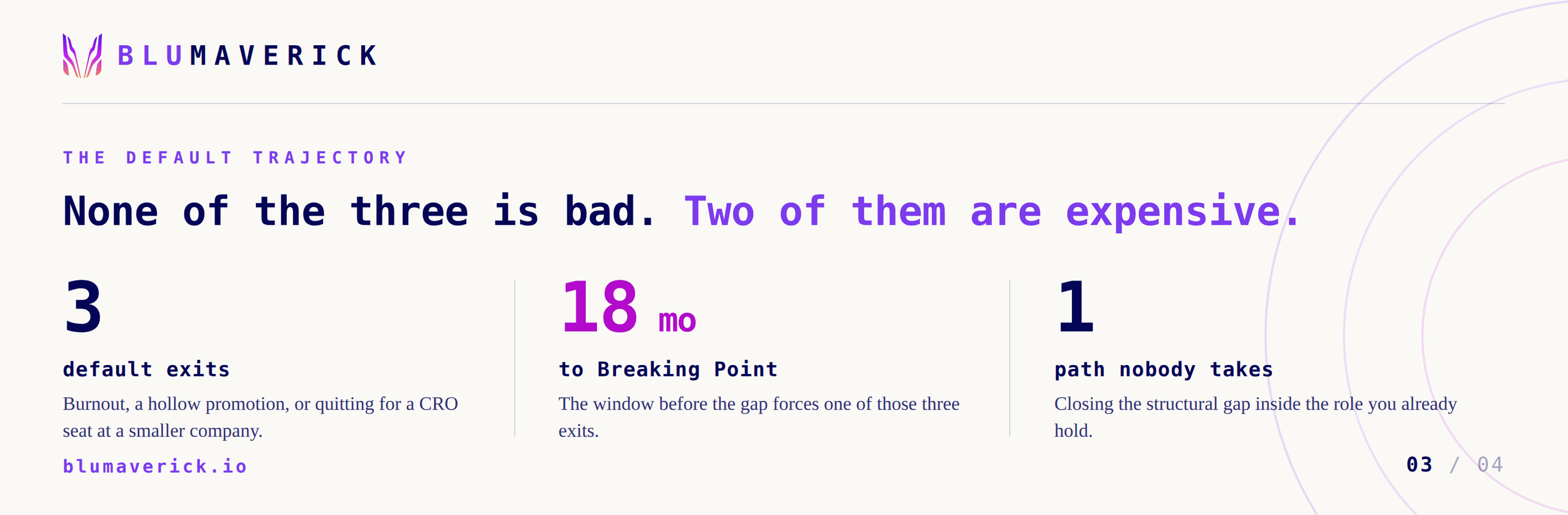
The fourth path — closing the structural gap inside the role you have — is the one almost nobody takes, because nobody has the language for it. The work isn't behavioral. It isn't communication coaching. It is structural redesign of the authority around a role that has already outgrown its mandate.
That's the work Blumaverick does — the Executive Authority Method™
Where to go from here
Read the IP. The AI Authority Gap™ Executive Brief is the foundational essay on what this gap is, why it's structural, and how it closes.
Map your gap. Take the 60-second Authority Gap Checklist→ now for a fast read on where your scope has outrun your title.
The role outgrew the title two years ago. The work now is making the structure catch up.
— Patricia Collins, Founder, Blumaverick
─────────────────────────────────────────
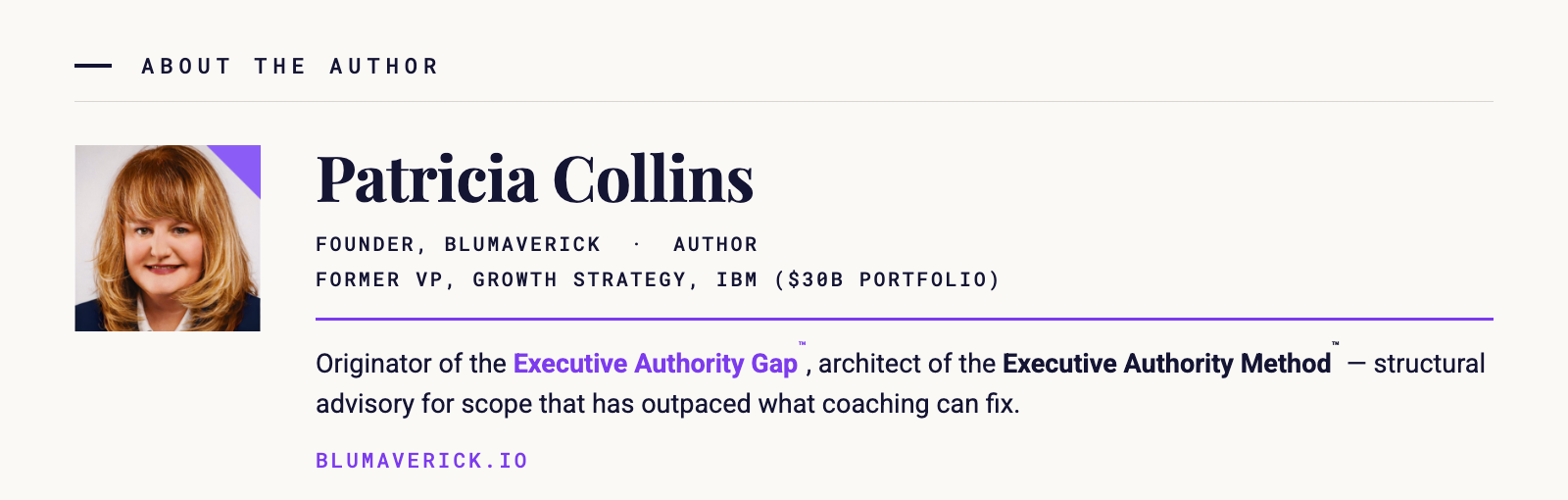
About the Author: Patricia Collins
Power moves that skip the org chart.
Continue exploring executive authority, structural diagnosis, and the moves that create momentum beyond formal title.
View more Sideways articles →