
Executive Advisor vs. Executive Coach: The Difference When You're Accountable for AI You Don't Own
A coach works on the executive’s presence. The gap AI is opening sits in the organizational structure around them.

The slide says AI-first. You are the one presenting it. You did not choose a single tool on it.
That sentence describes more senior executives in 2026 than the coaching industry has a category for. The AI stack inside your function was selected by operations, approved by IT, or inherited from a previous regime. The accountability for what it produces sits on one name in the org chart, and it is yours.
Every executive I have advised in the last twelve months arrived asking for the same thing. They asked for a coach.
Some of them needed one. Most of them needed something the market barely names — and does not really sell — because it is harder to package and more uncomfortable to deliver. They needed an executive advisor. Not a thought partner. Not a mentor. Not a coach with a sharper voice. An advisor whose work is to redesign the architecture around the executive, rather than build capacity in someone operating inside a structure that is the actual problem.
The distinction used to be academic. It is not anymore. AI is expanding the scope, accountability, and exposure of senior roles faster than any organisation can reprice them — which means the gap between what an executive carries and what their structure formally supports is now widening month over month.
The condition already has a common name: responsibility without authority. Accountable for outcomes you cannot fully authorise. It is the most searched description of the experience and the least useful one, because it describes the sensation and stops there — which is why the advice attached to it is always behavioural. Influence better. Build the coalition. Manage up.
The sensation is not the condition. Responsibility without authority is what it feels like from the inside. The Executive Authority Gap™(link this term to /blog/executive-authority-gap) is what it actually is: the structural failure that opens when scope scales faster than the formal authority architecture around it — mandate, decision rights, and organisational recognition all moving on slower cycles than the work. Its fastest-moving variant is the AI Authority Gap™(link this term to /ai-authority-gap): accountable for AI you do not own, cannot audit, and were never formally authorised to govern.
A feeling gets coached. A structure gets redesigned. That distinction is the entire buying decision.
The Difference at a Glance
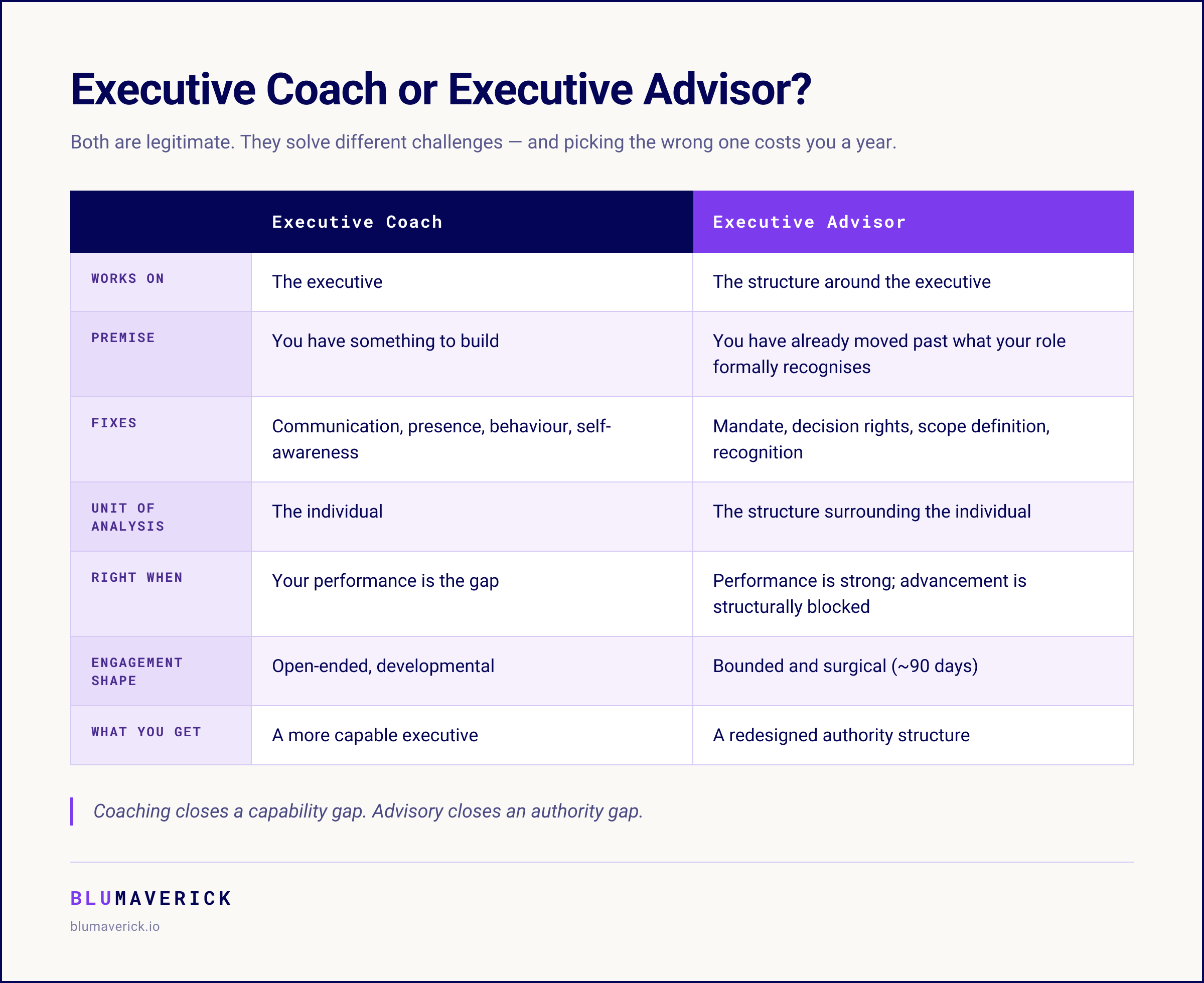
Executive Coach or Executive Advisor
You would not ask a tax advisor to process grief. You would not ask a therapist to file a return. Yet the executive market has settled on one category of help as the answer to every category of problem. Conflating the two is the most expensive category error a high-performing senior executive can make.
Why AI Changed Which Category You Need
This is the accelerant most executives are absorbing without naming it.
Gartner projects that roughly 20% of organisations will use AI to eliminate more than half of current middle-management positions by 2026. When the middle layers compress, the decisions that used to live in those layers route upward — at machine speed. The executive most capable of absorbing them inherits them. No formal mandate update. No expansion in authority. Additional scope, additional accountability, and additional decisions arriving on a calendar that was already full.
The shape differs by seat, but the structure is identical:
A revenue operations executive owns the entire go-to-market AI stack, makes the architectural calls, and reports to a chief revenue officer who cannot audit those choices. Full ownership of the infrastructure. No formal authority over the functions consuming it.
A marketing executive narrates an AI revenue strategy on the board call, while the tools generating the results were chosen elsewhere. The narrative authority is hers. The structural authority over what produces the narrative is not.
A Data or AI officer is appointed to govern enterprise AI with no headcount, no budget, and no veto. The title implies a mandate the org chart never assigned.
A risk executive holds regulatory, reputational, and model exposure for systems deployed in functions they do not control — with no structural lever to redesign the conditions producing that exposure.
None of these are confidence problems. None of them are visible in a 360 review. And none of them close through personal development, because the executive is not the variable that changed. The rate of structural change now exceeds the rate at which any individual can be built up to meet it. Coaching in that environment builds capacity in someone running uphill on ice.
The gap existed before AI. AI compresses the timeline on which it becomes catastrophic — what used to take a decade to surface inside a slowly evolving organisation now surfaces in two quarters.
─────────────────────────────────────────
The Gap Is Not a Transition. It Is the Operating Model.
Nearly 7 in 10 workers report taking on extra responsibilities in the hope it turns into a promotion. 73% say they have been asked to do work above their position. 78% are carrying larger workloads without additional compensation.
McKinsey research shows middle managers now spend nearly three-quarters of their time on work unrelated to talent management — and nearly 6 in 10 say new responsibilities are the most common reward for delivering.
Put plainly: the organisation expands what you do without expanding what you are.
That is no longer a transitional condition that resolves with the next reorg. It is the operating model. And the cost is visible in the failure data. One in three externally hired senior executives, and one in five internal hires, fail to meet organisational expectations by the two-year mark. When organisations are asked to diagnose why, only 15% of those failures are attributed to technical or business skill deficits. 68% are attributed to deficits that, examined closely, are almost entirely about politics, mandate, peer dynamics, and cultural alignment.
The failures are not capability problems. They are context problems.
Which changes the question.
Not how does this executive build further? but what structural conditions is this executive operating inside that no amount of personal work can fix?
That is the question executive coaching is not designed to answer.
What Executive Coaching Is — and Is Not
At its best, executive coaching is a behavioural discipline. The coach holds space for the executive to think out loud, surfaces blind spots, supports skill-building, asks the questions the executive is not yet asking.
The research is consistent on one point: coaching produces stronger outcomes at the micro level — individual behaviours, self-awareness, communication, decision clarity — than at the macro level of strategy execution and organisational performance (McDermott, Levenson & Newton, 2007). In plain language: coaching changes the executive. It rarely changes the conditions around the executive.
For a Director moving into a first VP seat, that can be exactly right — particularly where the gap is genuinely behavioural. For VPs, Directors, and newly-promoted C-suite executives whose performance is already strong and whose advancement is structurally blocked, it frequently is not. Not because the coach is wrong. Because the problem is not located inside the executive.
The Three Structural Conditions
Three conditions converge to create the gap. AI is accelerating all three.
One — scope without mandate. You are accountable for outcomes that depend on resources, decisions, and cross-functional authority you do not formally hold. You make it work through influence, late nights, and personal relationships — the bandwidth tax the organisation quietly relies on. Until it fails, you absorb it. Every AI system deployed into your function without a corresponding authority redesign raises that tax.
Two — decision rights without formalisation. You are routed to for decisions that should require your sign-off, but your authority to make them is informal. Someone above can override. Someone beside can veto. The organisation reads this as a relationship issue. It is a Decision Boundary Design™ issue — the rights were never formally assigned. When a vendor cycle moves weekly and the mandate moves annually, the compression is structural, not personal.
Three — perception lag. The organisation formed its opinion of your role before you moved past it. You can see how far your scope has expanded; the organisation cannot — because the structural signals (standing meetings, escalation paths, who you copy on what) were never redesigned to match.
A coach addresses none of these. They are not behavioural. They are structural.
Three Patterns I See in Every Engagement
The capable executive dropped into a new seat. Strong record, bigger role, inbox overflowing within weeks. Peers polite but distant — unclear on her mandate, protective of turf. She had company-provided coaching, which addressed her adjustment, presence, and communication. By month 14 the role was derailing — not because she was wrong for it, but because the mandate clarity, the formal authority over cross-functional dependencies, and the recognition architecture were never built. BTS finds roughly 40% of transitions fail within 18 months where structural support is absent.
The first-time executive who was always the reliable one. High performer, engaged team, ever-harder assignments handled deftly. Then the first executive seat landed and the structural conditions changed entirely: decisions that used to filter through layers now arrive directly; peers who used to collaborate now compete. His coach helped with executive presence and self-awareness. The actual problem was politics, mandate ambiguity, and structural authority never assigned to his expanded scope. This matches DDI's research on high-performer transition failure.
The executive asked to drive transformation without the authority to govern it. Transformation efforts fail at high rates, and rarely because of the business case. They fail because executives cannot detect resistance, misread silence as buy-in, or cannot address concerns the organisation never gave them formal authority to address. In 2026, that pattern has an AI-shaped version: the executive named accountable for enterprise AI adoption, with no veto over what other functions deploy.
In each pattern, coaching is the wrong tool — not because coaching is bad, but because the problem is not located inside the executive. It is in the architecture around them.
When to Hire Which One
Three diagnostics.
One. Has your performance been strong for three years, while you have been told you are doing the executive job but not formally? Then you are not in a behavioural gap. You are in a structural one. Coaching addresses the first; advisory the second.
Two. When a decision in your scope stalls, does it stall because you do not know what to do — or because you lack the formal authority to act? If it is the second, no amount of coaching closes it.
Three. Has anyone said "you're doing the executive job, we just haven't formalised it yet"? That is the most expensive sentence you will ever be told. It describes an active gap the organisation is benefiting from and not paying for.
Coaching is the right tool early, when the gap is genuinely behavioural, when presence or self-awareness is the limiting factor. In those conditions a good coach is one of the highest-leverage investments an executive can make.
Structural advisory is the right tool when your scope has outgrown your formal mandate, when decisions stall on authority you do not hold, when the organisation describes you in language calibrated to a smaller role than the one you are running — and when AI has moved that boundary faster than the org chart can follow.
What closes it is Structural Executive Authority™: the formal architecture of responsibility, decision rights, and recognition redesigned around the reality of the role. That redesign is the work of the Executive Authority Method™ — bounded, roughly 90 days, the same window in which most senior advancement decisions are made or missed.
If you want the fast read on where your own architecture is leaking, the Authority Gap Checklist uncovers the specific exposure that is opening underneath most senior roles right now.
The wealth advisor exists because at a certain scale of net worth, you cannot manage it yourself. The structural executive advisor exists because at a certain scale of authority gap, you cannot redesign it from the inside.
Frequently Asked Questions
Is this just executive coaching by another name? No — and the difference is structural, not semantic. Coaching is a behavioural discipline focused on the executive. Structural advisory focuses on the architecture around them: formal authority, decision rights, organisational recognition. A coach asks what you want to work on. A structural advisor diagnoses the conditions you cannot see from inside the role, and redesigns the structure that closes the Executive Authority Gap™.
I already have a coach. How do I know if I need an advisor instead? Ask whether your gap is behavioural or structural. If your performance is strong, your scope has expanded beyond your title, and your advancement is stalling for reasons unrelated to how you show up, coaching is not the bottleneck. The architecture around you is. That is what the Executive Authority Method™ is built to address.
Does being accountable for AI change the answer? It sharpens it. AI accountability lands on executives who did not select the systems, cannot audit them, and hold no formal governance authority over the functions deploying them. That is a mandate and decision-rights problem in every case, and no behavioural intervention reaches it. The AI Authority Gap™ is the variant of this condition that is compounding fastest.
Next Step:
MAP THE GAP→.Begin the Executive Authority Checklist.
60 seconds. Mark where it's most acute. Get your gap named. No Commitment. No Obligation
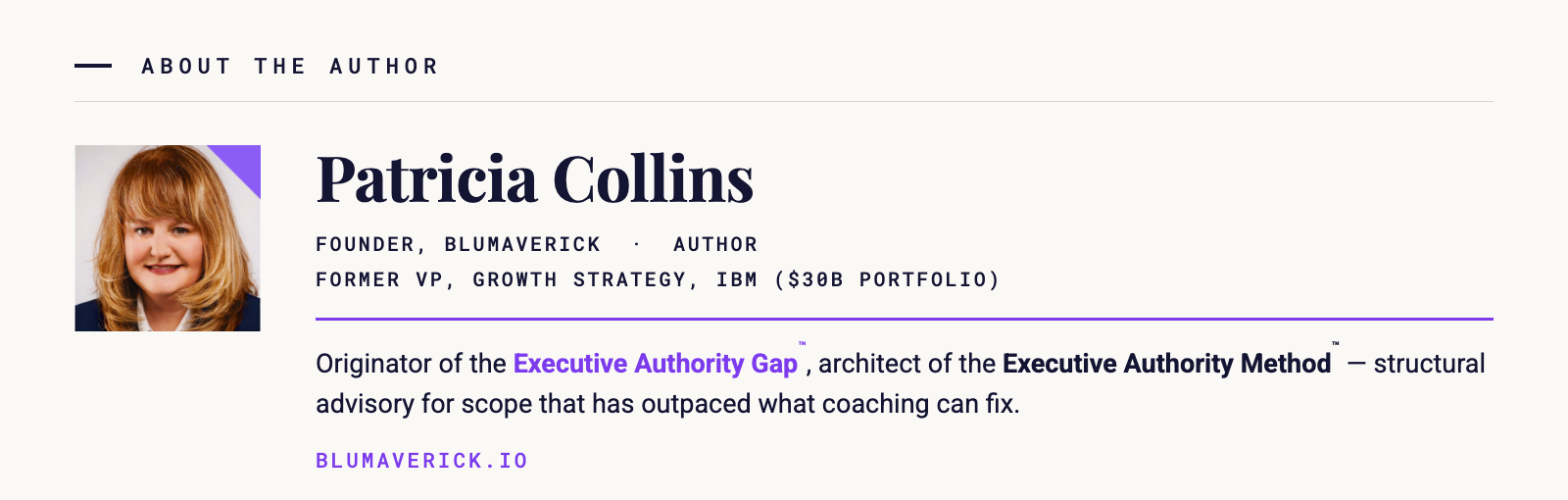
About the Author: Patricia Collins
─────────────────────────────────────────
Blumaverick · Responsibility without Authority • blumaverick.io
─────────────────────────────────────────
SOURCES
1. JobSage — Employee Experience Statistics 2023 — https://www.jobsage.com/employers/employee-experience-statistics-to-know-in-2023/
2. McKinsey — Leadership transition failure data — referenced research on ~50% transition failure rate
3. McKinsey — Untangling Your Organization’s Decision Making — https://www.mckinsey.com/capabilities/people-and-organizational-performance/our-insights/untangling-your-organizations-decision-making
4. Gartner — Top Predictions for IT Organizations and Users in 2025 and Beyond (October 2024) — https://www.gartner.com/en/newsroom/press-releases/2024-10-22-gartner-unveils-top-predictions-for-it-organizations-and-users-in-2025-and-beyond
5. Institute of Executive Development + Alexcel — Senior leadership transition study (executives in top 5% of organisations, 12 countries, 21 industries)
6. McDermott, Levenson, Newton (2007) — Evaluating the effectiveness of executive coaching: Beyond ROI?
7. BTS — Why executive transitions go wrong — https://bts.com/insights/executive-transition-failure-causes-solutions/
8. DDI — Why Executive Transitions Continue to Fail — https://www.ddi.com/blog/executive-transitions
9. Capterra — Middle Manager Burnout — https://www.capterra.com/resources/middle-manager-burnout-strategies/
───────────────────────────────────────
This is not executive coaching. It is structural advisory for leaders whose scope has already outpaced what coaching can fix.
Connect on LinkedIn · blumaverick.io
Power moves that skip the org chart.
Continue exploring executive authority, structural diagnosis, and the moves that create momentum beyond formal title.
View more Sideways articles →