
How Executives Prepare to Lead Through Rapid Technological Change
Byline: Patricia Collins ran growth strategy across IBM's $30B Cloud & Systems portfolio — the infrastructure enterprise AI runs on — and held the CMO seat at EVRYTHNG, one of the first IoT startups. She now advises executives on the AI Authority Gap.
Coaches work on the leader. A structural advisor works on the architecture around the leader. That distinction is the buying decision.
Executives prepare for rapid technological change less by adding tools and more by fixing structure.
As AI and automation spread, accountability for outcomes outruns the authority to govern them.
The executives who stay ahead — close the gap between what they're accountable for and what they're authorized to control.
The standard advice is necessary — and incomplete
Most guidance on this question converges on the same five moves: build tech fluency, create shared accountability across functions, run fast pilots, invest in reskilling, and stand up AI governance before broad rollout. All of it is correct. All of it is table stakes.
And all of it describes what an executive should do — without asking whether that executive has been given the authority to do it. That is the variable almost no one names, and it's the one that decides who actually leads through technological change and who simply absorbs the blame when it goes wrong.
The Missing Variable: Structural Authority
Here is the pattern playing out inside most enterprises right now. A VP, Director, or new C-suite leader is made accountable for an AI or automation initiative. The mandate spans functions they don't own. The tools are deployed by teams that don't report to them. The board hears about it from someone above them. When a model misfires or a rollout stalls, it lands on the accountable executive — who never held the authority to govern the thing they're answerable for.
Blumaverick calls this the AI Authority Gap™: the structural condition in which an executive is held accountable for AI-driven outcomes without being granted the authority. It is the technology-specific case of the broader Executive Authority Gap™ — and preparing for technological change means closing it, deliberately, before the next deployment.
How executives actually prepare
Build enough technology fluency to understand the strategic implications of AI, data, and automation. You do not need to become the technical expert in the room. You do need to understand the business consequences of the decisions being made.
Clarify ownership before complexity arrives. As organizations adopt new technologies, responsibilities often expand faster than roles, reporting structures, and governance. The executives who navigate this well make expectations explicit early rather than relying on assumptions later.
Pay close attention to where responsibility accumulates. When outcomes, risk, and expectations begin converging on a single role, it is worth examining whether the surrounding organizational structure has evolved to support that reality.
Address governance questions before they become operational problems. Decisions about oversight, accountability, risk, and escalation are easier to make before pressure arrives than after a problem emerges.
Focus on creating alignment. The most effective organizations ensure that responsibilities, expectations, resources, and authority evolve together as technology adoption accelerates.
Why this is the real preparation gap
The data shows accountability spreading faster than authority. Gartner found that 45% of CIOs are driving a shift to co-ownership of digital leadership — accountability distributed across IT and the business. Separately, roughly 72% of large companies now run on some form of matrix structure, where authority and accountability are shared until clarity thins out (Gartner).
And accountability is now the lowest-rated executive competency measured, with fewer than half ofexecutives rating themselves effective at creating it (Gallup, 2026).
Put together, the picture is clear: organizations are handing executives more accountability for technology and less of the authority to govern it. The executives who prepare for that — by building the structure, not just the skills — are the ones who stay ahead of the change instead of carrying the fallout from it.
How should an executive prepare to govern AI they're accountable for?
Preparation begins with understanding how responsibility, governance, and organizational expectations intersect.
As AI and automation become more embedded in business operations, misalignment between those elements can create unnecessary risk, friction, and confusion.
The organizations that navigate this transition most effectively are the ones that address those questions early—before growth, complexity, or a critical event forces them into the open.
Who is accountable when an AI system an executive oversees gets it wrong?
Legally and organizationally, responsibility for AI outcomes rests with the people and organizations that deploy and oversee the technology.
As adoption accelerates, the challenge is rarely the technology alone. It is ensuring that governance, accountability, and organizational structures evolve alongside it.
The most resilient organizations address those questions early, before growth, complexity, or unexpected outcomes force them into the spotlight.
If you recognize the pattern, the next step isn't another framework — it's a clear read on where your accountability has outrun your authority.
Three paths from here
Read the IP. The AI Authority Gap™ Executive Brief is the foundational essay on what this gap is, why it's structural, and how it closes.
Map your gap. Take the 60-second Authority Gap Checklist now for a fast read on where your scope has outrun your title — and you're first in for BluShift™, which maps the patterns in your seat and the levers to pull, when it opens end of June. blumaverick.io/blushift
Request a Private Preliminary Briefing. For executives whose authority gap has become a structural risk — I offer a confidential 30-minute briefing before any discussion of engagement. Request it through the Authority Auditpage. I respond personally.
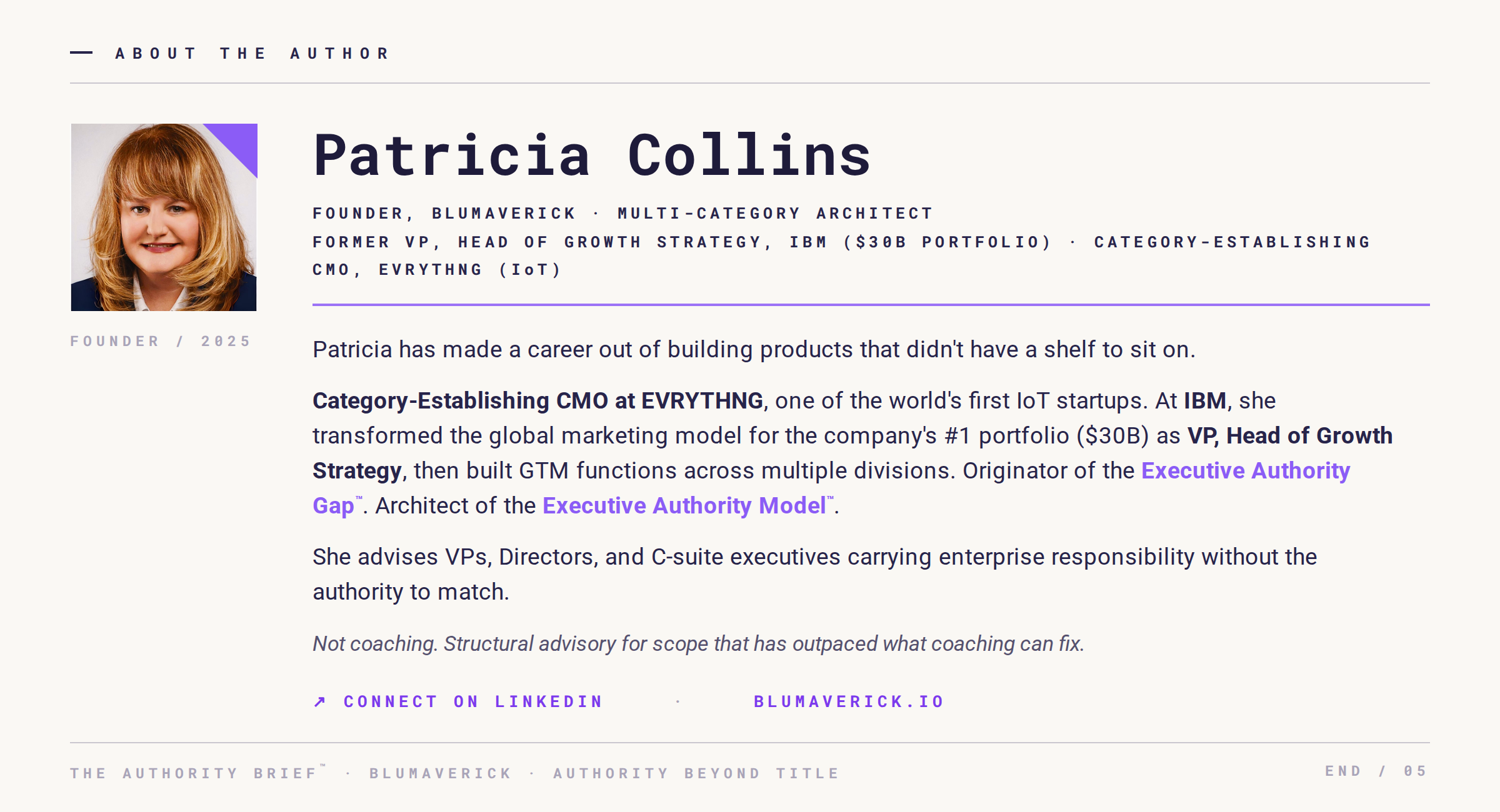
Patricia Collins • Author • Founder, Blumaverick
Sources: Gartner, CIO survey on co-ownership of digital leadership, 2023 · Gartner, share of multinationals using matrix structures, 2024 · Gallup, accountability as the lowest-rated leadership competency, 2026.
#GTM, #RevOps, #B2BMarketing, #DemandGen, #CMO, #ChiefRevenueOfficer, #Sales, #ProductMarketing #AIAuthorityGap #DigitalTransformation
Power moves that skip the org chart.
Continue exploring executive authority, structural diagnosis, and the moves that create momentum beyond formal title.
View more Sideways articles →