
Executive Advisor vs Executive Coach: The Difference That Matters for VPs Who Are Already Performing
Coaches work on the leader. A structural advisor works on the architecture around the leader. That distinction is the buying decision.
Byline: Patricia Collins · Founder, Blumaverick | Former Pioneer CMO · Ex-IBM VP Head of Growth Strategy ($30B)
───────────────────────────
If you are a VP or Director searching for the difference between an executive coach and an executive advisor, you are likely already in the gap that neither category is fully designed to address.
You have been to coaching. Two engagements, maybe three. Your feedback is excellent. Your performance reviews are strong. Your scope keeps growing.
And you are still not advancing at the pace your results would suggest you should be.
You are not asking this question because you do not know what coaching is. You are asking it because coaching is not working — and you are trying to name what would.
The short answer — what most people get wrong
An executive coach develops the person. An executive advisor diagnoses and redesigns the system around the person. Coaching is for skill-building and behavioral development. Advisory is for VPs and Directors whose performance is already at the level the role requires — and whose advancement is being blocked by structural conditions (decision rights, organizational perception, formal authority) that no amount of personal development can fix from the inside.
That is the difference that matters for the buying decision.
Most articles on this topic frame the question as "which one is better for you?" — as if both are valid options on the same spectrum. They are not. They solve different problems. Buying the wrong one wastes 18 months and several thousand dollars per month.
Where the categories actually diverge
Coaching is about the leader
Executive coaching, at its best, is a behavioral and developmental discipline. The coach holds space for the leader to think out loud, surfaces blind spots, supports skill-building, and asks the questions the leader is not yet asking themselves.
The premise of coaching is that the leader has something to develop — communication, presence, emotional regulation, conflict skills, strategic thinking — and that the development happens inside the leader.
For professionals earlier in their trajectory stepping into management, coaching works.
For Directors moving into their first VP role, coaching can work — particularly when the gap is genuinely behavioral.
For VPs and Directors whose performance is already strong and whose advancement is structurally blocked, coaching frequently does not work. Not because the coach is wrong. Because the problem is not located inside the leader.
Advisory is about the architecture
A structural executive advisor — which is what Blumaverick is — does not develop the leader. The leader does not need more development. The leader has already developed past what their current role formally recognizes.
What the advisor does is diagnose the Executive Authority Gap™ — the structural condition where a leader's operational scope has outgrown the formal mandate, decision rights, and organizational perception around them — and architect the redesign that closes it.
That is a different category of work entirely. It is closer to org design than it is to coaching. The unit of analysis is not the leader. It is the structure of authority surrounding the leader.
This is why advisory engagements at Blumaverick resolve typically within ~90 days. The work is structural, bounded, and surgical — not open-ended developmental work.
The diagnostic question that separates the two
Here is the question that will tell you which category you actually need:
When you imagine what would change your trajectory, do you imagine yourself behaving differently — or do you imagine the organization recognizing, formalizing, or restructuring something around you?
If the answer is the first one — coaching may help.
If the answer is the second one — coaching cannot help, no matter how good the coach is. You need a structural advisor.
Most VPs and Directors who have already invested in coaching are in the second category. They have already done the personal development. The block is no longer in them.
What coaches cannot do, structurally
This is not a critique of coaches. It is a description of category limits.
A coach cannot redesign your decision rights. They cannot rewrite how your scope is formally defined. They cannot resequence the political map of your leadership team. They cannot get the CEO to formalize the authority you are already operating with informally. They cannot change how the organization perceives your role.
None of that is in the coaching toolkit. It is not a deficiency. It is a category boundary.
A coach can prepare you to have those conversations. A coach can build your confidence going into them. A coach cannot architect what happens on the other side.
That is what a structural advisor does — and that is why the two roles look similar from the outside and feel completely different on the inside.
This is the kind of structural pattern I unpack every week in my LinkedIn newsletter. Subscribe here →
What the work actually looks like — coach vs. advisor
DimensionExecutive CoachStructural Executive AdvisorUnit of analysisThe leaderThe architecture around the leaderPremiseThe leader has development to doThe leader has structure to redesignBest forSkill-building, behavioral developmentStalled advancement despite strong performanceEngagement length6–12 months, often ongoing~90 days, boundedDeliverablePersonal growth, expanded capacityRedesigned decision rights, organizational perception, formal authorityOutputThe leader changesThe structure changesBuyer's question"Help me grow into this role""Help me get the structure to match the role I am already in"
Buyers who confuse the two end up frustrated.
A buyer who needs structural advisory but buys coaching spends 12 months "developing" things they had already developed. They emerge confident, polished, well-spoken — and still passed over.
A buyer who needs coaching but buys advisory finds the conversation moving too quickly past the developmental work that would actually help.
The categories are not better-or-worse. They solve different problems. The buying decision is about which problem you actually have.
How to tell which one you are
Three diagnostics for the VP or Director trying to decide.
One — has the feedback you have received changed in the last two years?
If your reviews have been consistent and strong for two years running, and the gap between your performance and your advancement is widening, the issue is not behavioral. It is structural. Coaches improve behavior. Advisors fix structure.
Two — does your current scope match your current title?
If you are running scope that is materially larger than what your title formally defines — direct reports beyond your level, decisions beyond your stated authority, accountability for outcomes that route through other functions — your gap is structural by definition. The org has expanded what you do without expanding what you are.
Three — has someone in the organization told you "you are doing the executive job, we just have not formalized it yet"?
If yes, that sentence is the most expensive sentence you'll hear at this level. It describes an active Executive Authority Gap™ the org is benefiting from and not paying for. No coach can close it. Only a redesign of the structural conditions can.
Where Blumaverick fits
Blumaverick is a private executive advisory firm for VPs and Directors operating above their title. We engineer Structural Authority™ — the decision rights, organizational perception, and formal mandate that make the executive work you are already doing visible, attributable, and structurally compensated.
We do this through Executive Authority Method™, applied diagnostically via the BluShift™ authority assessment. Engagements typically resolve within ~90 days — the same timeframe in which most VP and Director advancement decisions get made or missed.
This is not coaching. It is structural advisory for leaders whose scope has already outpaced what coaching can fix.
If you are searching for the difference between an executive coach and an executive advisor, you are likely past the point where the first category can help. The second category is a different conversation entirely.
You're likely in the gap when:
You are accountable for outcomes, but not part of the decisions shaping them
Your scope has expanded — your authority has not
You are operating across functions without clear ownership
You spend more time aligning stakeholders than making decisions
Your title and compensation do not reflect the responsibility you are carrying
You are consistently "almost ready" — but not advancing
If this is your situation, the first step is a brief.
Apply for the Executive Authority Brief™ →
Get the next one in your inbox.
Every week, one structural pattern that's costing high-performing VPs and Directors their next promotion — and what closes the gap. Written for executives tired of being told they need more "executive presence."
Subscribe on LinkedIn →
No fluff. No cohort. Just the patterns Patricia sees inside the work.
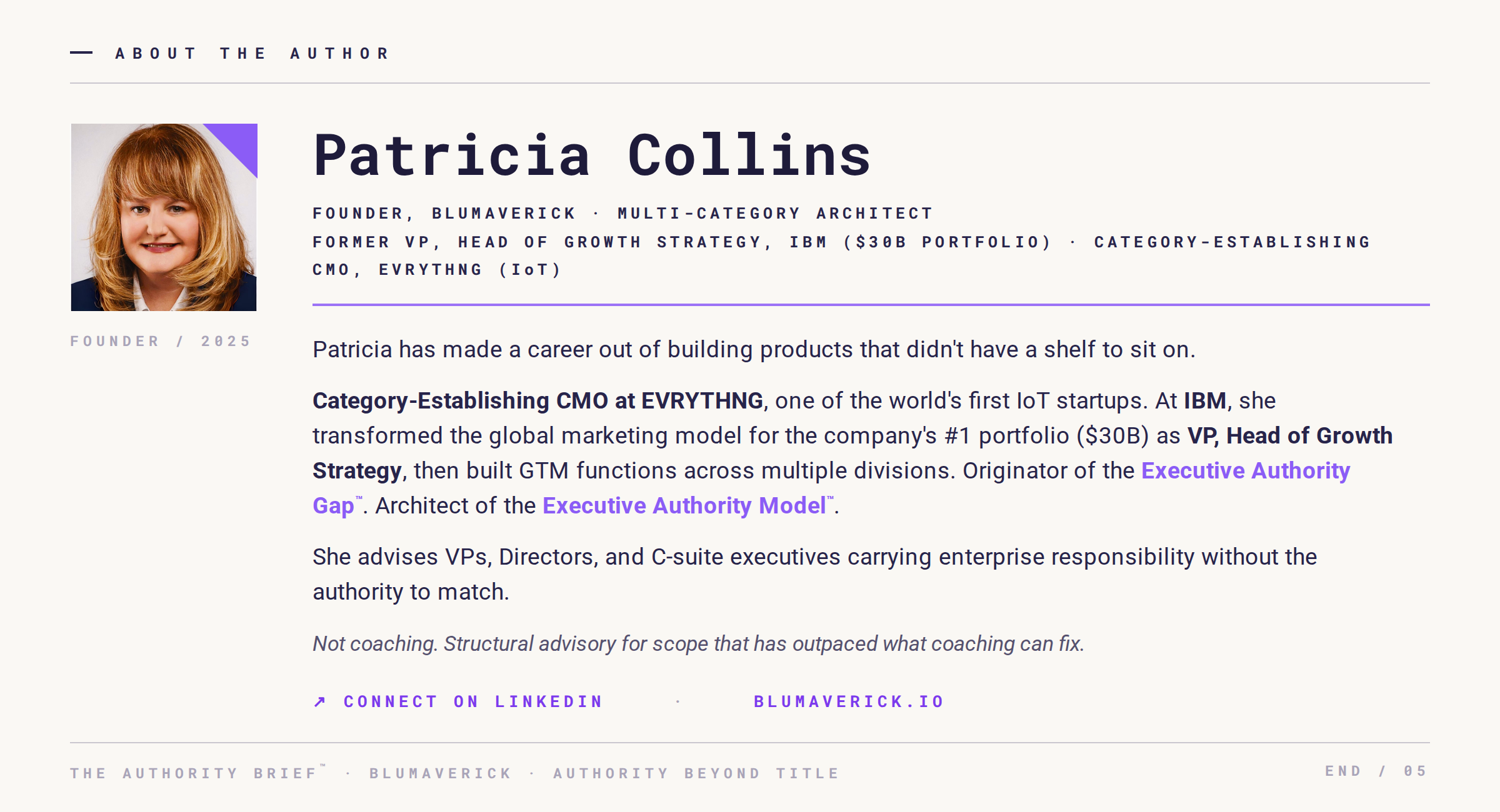
She works with a small number of executives at a time to resolve this — typically within ~90 days.
This is not executive coaching. It is structural advisory for leaders whose scope has already outpaced what coaching can fix.
Connect on LinkedIn · blumaverick.io
Power moves that skip the org chart.
Continue exploring executive authority, structural diagnosis, and the moves that create momentum beyond formal title.
View more Sideways articles →