
Structural Authority: What Actually Gives an Executive Power

Two executives. Same title, same tenure, comparable track records.
One walks into the room and decisions move — budgets shift, other functions adjust, the call gets made. The other walks into the same room, delivers the same quality of thinking, and nothing happens. The work gets admired. Then it gets routed around.
The difference isn't talent. It isn't confidence, presence, or how well they "show up." It's structural authority — and most executives have never been told it's a separate thing they can be missing.
Four kinds of authority — and only one of them moves the organization
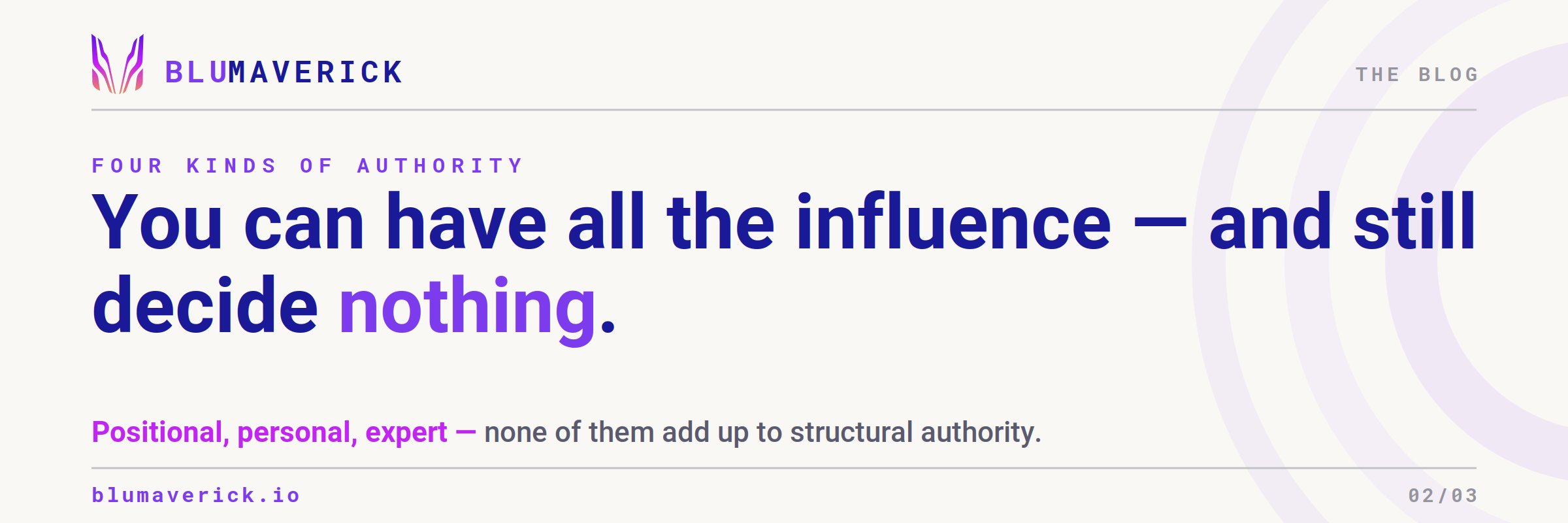
Many executives assume that influence and responsibility naturally translate into organizational authority.
They often do not.
It is entirely possible to be highly trusted, widely consulted, and deeply relied upon while still operating within structures that limit your ability to shape outcomes. It has a name. Responsibility without Authority.
When that disconnect persists, organizations create friction for both the executive and the business.
The issue is rarely individual capability.
More often, it is a question of organizational design.
What they don't have is the structural authority to decide — to set direction, move resources, and override a bad call without seeking permission from someone whose name isn't on the outcome.
The disorienting part is that you can have enormous influence and still not be able to decide anything. You can be the most trusted person in the building and still spend your quarters working around a structure that never handed you the mandate. That's not a personal failing. It's a design gap — the one we call the Executive Authority Gap™.
Why coaching and "executive presence" don't close it
The default fix for an executive who isn't operating at full leverage is individual development: coaching, visibility strategies, executive‑presence training. None of it is wrong. It just solves the wrong layer.
Coaching builds personal authority. Presence training sharpens how you're perceived. Both make a capable executive more capable. If the problem is that your title doesn't match your responsibility, a better version of you runs straight back into the same wall — now with more polish and the same inability to act.
This is the quiet trap behind responsibility without authority: the organization keeps investing in the person and never redesigns the structure, so the person improves and the gap stays exactly where it was.
Structural authority is designed, not earned
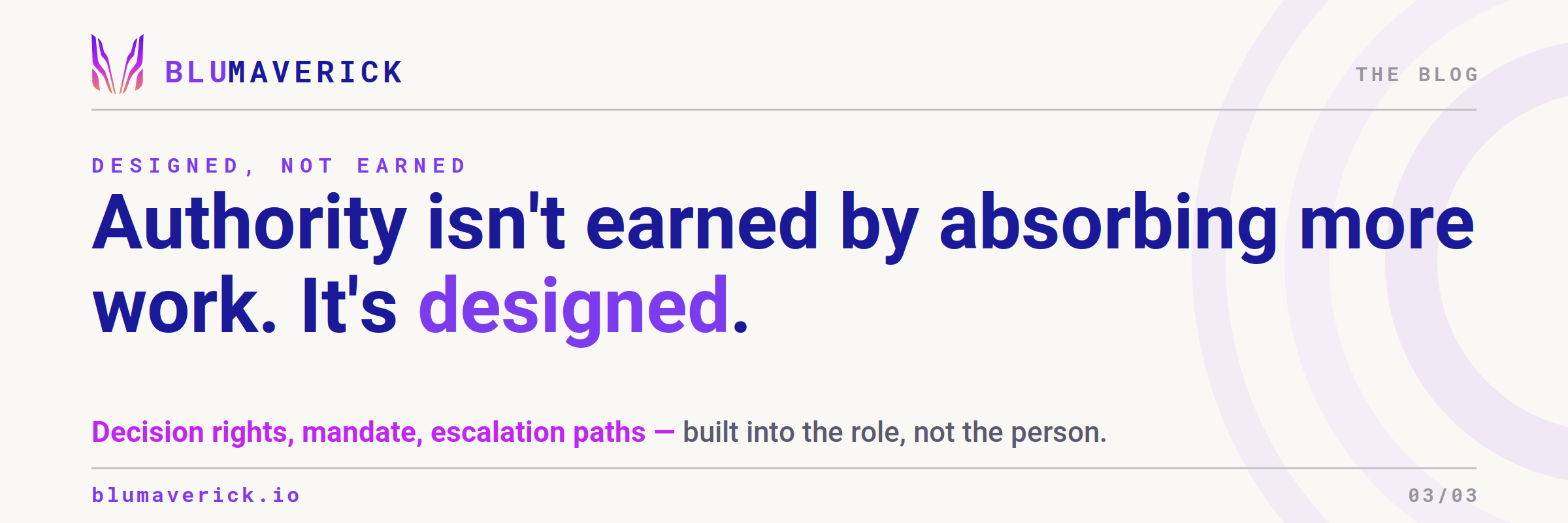
A common assumption is that authority grows automatically as responsibility grows.
Often, it doesn't.
Organizations regularly expand expectations faster than they adapt the structures supporting those expectations.
The result is predictable: increasing complexity, slower decisions, and growing friction between what executives are expected to deliver and what their role was originally designed to support.
At some point, the question is no longer about performance.
It becomes a question of organizational design.
What this means for you
If your responsibility keeps expanding while your authority sits still — if you're carrying executive‑level accountability without executive‑level authority — that is not a confidence problem, and it's not something more output will fix.
It's a missing layer of authority that has to be built.
If you're carrying this right now, the gap won't close on its own — the first step is seeing exactly where it sits.
Begin Your Private Conversation. For executives whose authority gap isnt aligned with what you are carrying and it’s time for a change — I offer a confidential 30-minute briefing before any discussion of engagement. →
Not there yet?
Take BluShift™ — a 60-second self-assessment that maps the gap.→
See also: when your scope exceeds your authority.

Power moves that skip the org chart.
Continue exploring executive authority, structural diagnosis, and the moves that create momentum beyond formal title.
View more Sideways articles →