
When Your Scope Exceeds Your Authority: A Structural Problem, Not a You Problem
Byline: Patricia Collins ran growth strategy across IBM's $30B Cloud & Systems portfolio — the infrastructure enterprise AI runs on — and held the CMO seat at EVRYTHNG, one of the first IoT startups. She now advises executives on the AI Authority Gap.
The reorg added two functions to your plate. A departing peer's team folded into yours.
The board deck became yours to present. Your scope grew in every direction at once.
Your authority didn't move an inch.
You're now accountable for more than you're allowed to decide — running at a level the org chart never updated to reflect. This is one of the most common conditions at the VP, Director and C Suite level, and almost no one names it correctly. They call it a stretch. A growth opportunity. High‑potential trajectory. What it actually is: scope exceeding authority — a structural problem wearing the costume of a personal one.
What it looks like from the inside
You're accountable for outcomes you don't have the authority to decide.
Your remit spans teams you don't formally own.
You spend more time aligning stakeholders than making calls.
Every real decision requires re‑seeking permission from someone whose name isn't on the result.
From the outside it looks like growth. Inside, it's friction — and over enough quarters, it's a stall.
Why it happens — and why it isn't your fault
Organizations scale faster than their governance models evolve, and most now run on structures that manufacture this gap by default. Roughly 72% of large companies operate as some form of matrix(Gartner, 2024), where authority and accountability are shared until clarity thins out. As layers flatten, work lands on fewer people and ownership spreads across functions.
Meanwhile, accountability is the lowest‑rated leadership competency measured — fewer than half of leaders rate themselves effective at creating it (Gallup, 2026).
So instead of redesigning roles to match the new reality, organizations do something simpler: they rely on capable operators to absorb the gap. It's efficient — for the org. It gets executive‑level output without building executive‑level structure. The cost lands on you, in time and trajectory and years spent running a job you were never authorized to run. That's the responsibility without authority shortcut, and the Executive Authority Gap™ is the measurable distance it leaves behind.
Why more performance won't fix it
The instinct is to work harder — prove you can handle the expanded scope, and surely the authority will follow. It rarely does. Demonstrating you can absorb the gap is exactly what signals the organization that it doesn't need to close it. The more reliably you carry it, the more you get handed.
That's the difference between a performance problem and a structural one. Performance problems respond to effort. Structural problems respond only to redesign.
What actually closes it
The authority gap doesn't close on its own — it closes by design. This is what Blumaverick was built to solve.
If you recognize the pattern, the next step isn't another article — it's a clear read on where you stand.
Read the IP. The AI Authority Gap™ Executive Brief is the foundational essay on what this gap is, why it's structural, and how it closes.
Map your gap. Take the 60-second Authority Gap Checklist now for a fast read on where your scope has outrun your title — and you're first in for BluShift™, which maps the patterns in your seat and the levers to pull, when it opens end of June. blumaverick.io/blushift
Request a Private Preliminary Briefing. For executives whose authority gap has become a structural risk — I offer a confidential 30-minute briefing before any discussion of engagement. Request it through the Authority Audit. page. I respond personally.
This isn't executive coaching. It's structural advisory — for executives whose scope has already outpaced what coaching can fix.
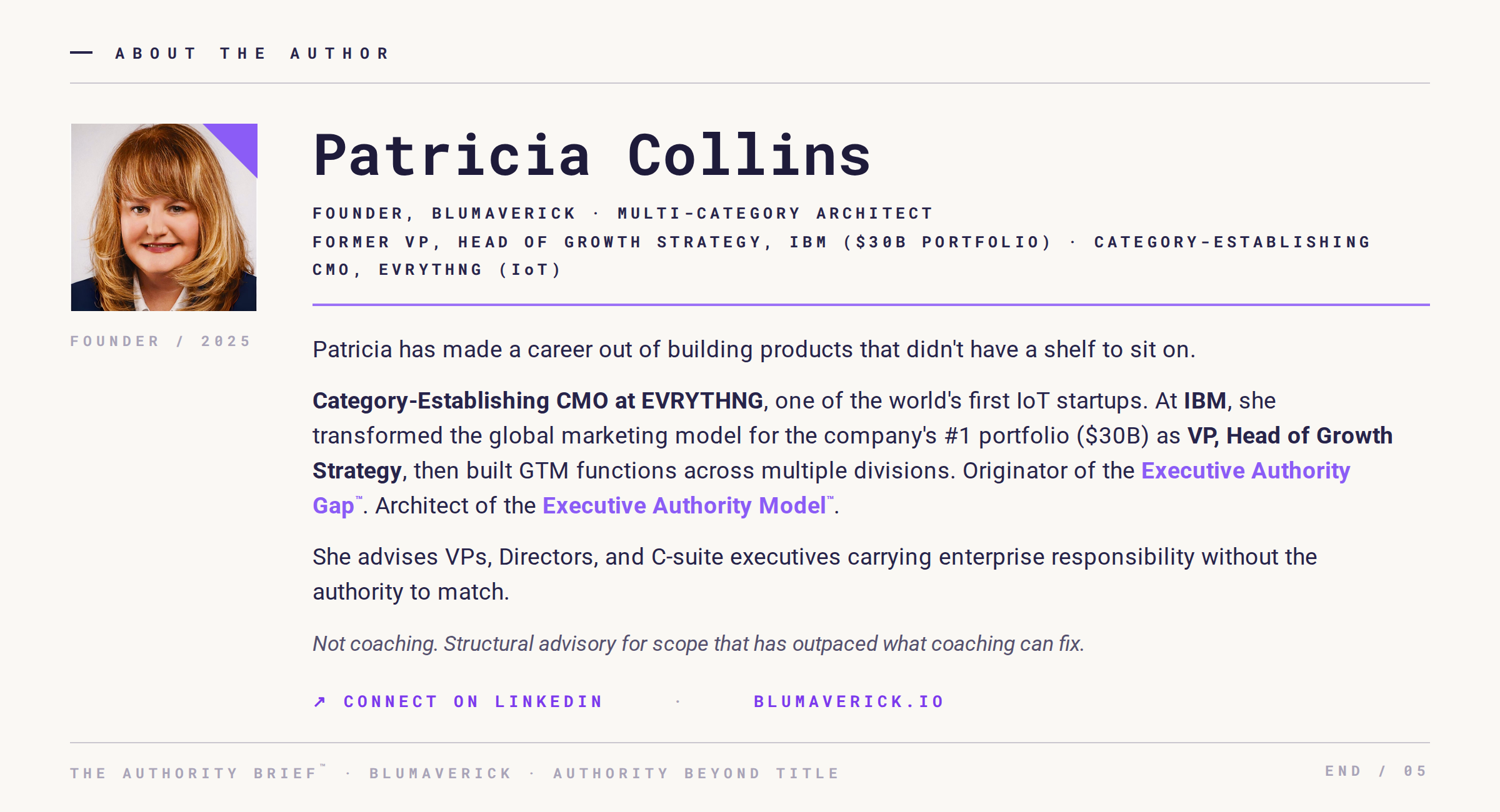
Patricia Collins, Founder & Author, Blumaverick
Sources: Gartner, share of multinationals using matrix structures, 2024 · Gallup, accountability as the lowest‑rated leadership competency, 2026.
#EnterpriseAI, #AIGovernance, #ChiefDataOfficer #COO #ChiefRiskOfficer #GTM, #RevOps, #CMO, #ChiefRevenueOfficer, #ProductMarketing. #accountablebutnoauthority
Power moves that skip the org chart.
Continue exploring executive authority, structural diagnosis, and the moves that create momentum beyond formal title.
View more Sideways articles →