
The Responsibility Without Authority Shortcut — And Why It Stalls Your Career.
Byline: Patricia Collins · Founder, Blumaverick · Category-Establishing IoT CMO · ex-IBM VP, Head of Growth Strategy ($30B Cloud)
It's 10:47 PM on a Monday.
Marcus has his laptop open, QBR deck on one screen, Slack on the other. He's been at this for three hours. Not because the numbers are hard. Because he knows exactly how tomorrow plays out — and none of it is in his control.
He'll walk into that room at 9 AM and stand in front of the Managing Director and the full portfolio leadership team. He'll present the numbers. He'll own the narrative. He'll field the questions.
And when someone asks why Q1 came in short — and someone always does — it will land on him.
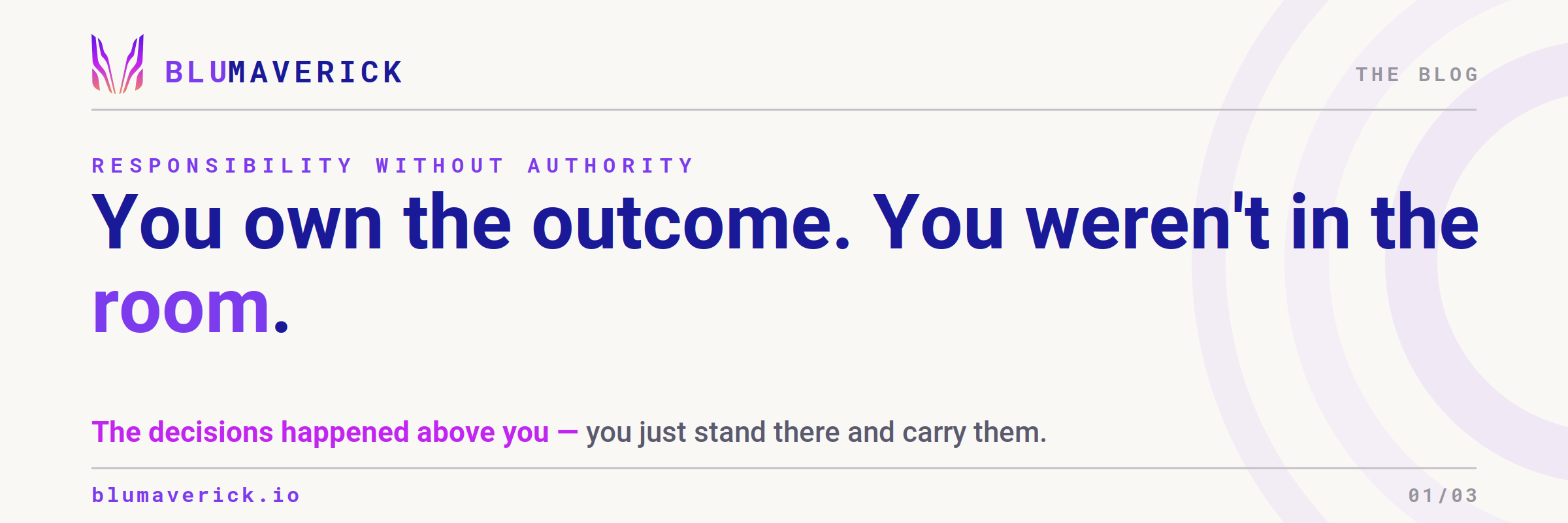
Responsibility without Authority
Even though he wasn't in the room when the decisions were made. Even though the pricing call happened above him. Even though the resource reallocation that shifted his team mid‑quarter was signed off before he heard about it.
He'll still be the one standing there with it. Explaining it. Defending it. Carrying it.
He closes the laptop at midnight. Tomorrow he'll deliver the presentation. He'll do it well — he always does. And then next quarter, it will happen again.
What Marcus is living in has a name. It's called responsibility without authority. And in most organizations, it's not an accident. It's a design choice.
At the VP and Director level, roles stop being clearly defined. Decision‑making authority blurs. Ownership spreads across functions. The structure lags behind the work.
So instead of redesigning roles to match the reality, organizations do something simpler. They rely on people like Marcus. People who are capable enough to absorb the gap. People who will step in, fill what's missing, and carry it across the line.
It works — for the organization. Decisions happen without Marcus. Performance benchmarks still get hit. The org gets executive‑level output without building executive‑level structure around it.
And Marcus? He gets pulled into more special projects. More complexity. More exposure. Longer nights. He's proven he can handle it. So they give him more to handle.
From the outside, it looks like growth. Inside, something doesn't move. He's still not in the decisions. He's still not setting direction. He's still working around a structure that was never built for what he's actually doing.
Responsibility without authority. That's the shortcut. Organizations use it constantly. Give someone enough accountability to keep things moving. Don't give them the authority to change anything. Call it development. Call it exposure. Call it high‑potential trajectory.
It costs the organization nothing. It costs Marcus everything — in time, in trajectory, in the years that pass while he waits for a structure that never gets built around him.
This isn't anecdote. It's structure — and it's measurable.
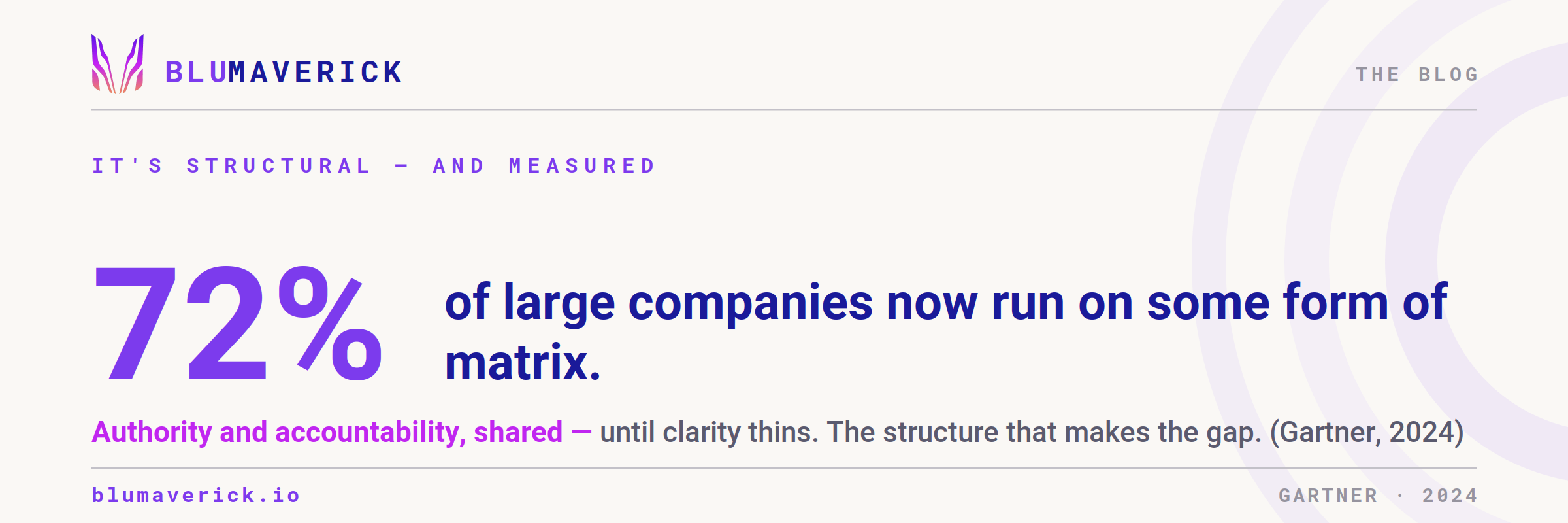
It’s Structural - and - Measured
Roughly 72% of large companies now run on some form of matrix, and even those without a formal one operate that way — multiple bosses, cross‑functional ownership, shared accountability (Gartner, 2024). By design, matrix structures spread authority and accountability until clarity thins out.
Accountability is now the lowest‑rated leadership competency measured — fewer than half of leaders rate themselves effective at creating it, and clarity of expectations keeps declining (Gallup, 2026).
Management research has even named the condition: an "authority gap," where leaders are held accountable without the decision‑making power their roles require (People Management / CMI, 2025).
The pattern is exactly Marcus's: capable people quietly compensating for the structural gap by absorbing work the org should own — and the more reliably they do it, the more they get handed.
When to Question How Your Role Is Actually Structured
You're likely here when:
You're accountable for outcomes, but not part of the decisions shaping them
Your role has expanded, but your decision‑making authority hasn't
You're operating across teams without clear ownership
You spend more time aligning stakeholders than making decisions
At first, it feels like growth. Over time, it becomes friction. It starts to feel normal. But it isn't. It's a signal your role isn't structured for the level you're operating at.
The Bottom Line
Responsibility without authority isn't executive development. It's how organizations keep work moving without fixing the structure underneath it. That's the shortcut.
And if you're carrying this right now — the gap won't close on its own — the first step is seeing exactly where it sits.
The Executive authority gap doesn't close on its own — it closes by design.

The Bottom Line
If you recognize the pattern, the next step isn't another article — it's a clear read on where you stand.
To request a private briefing, send me a direct message with the word Briefing.
Connect on LinkedIn · More from Patricia →
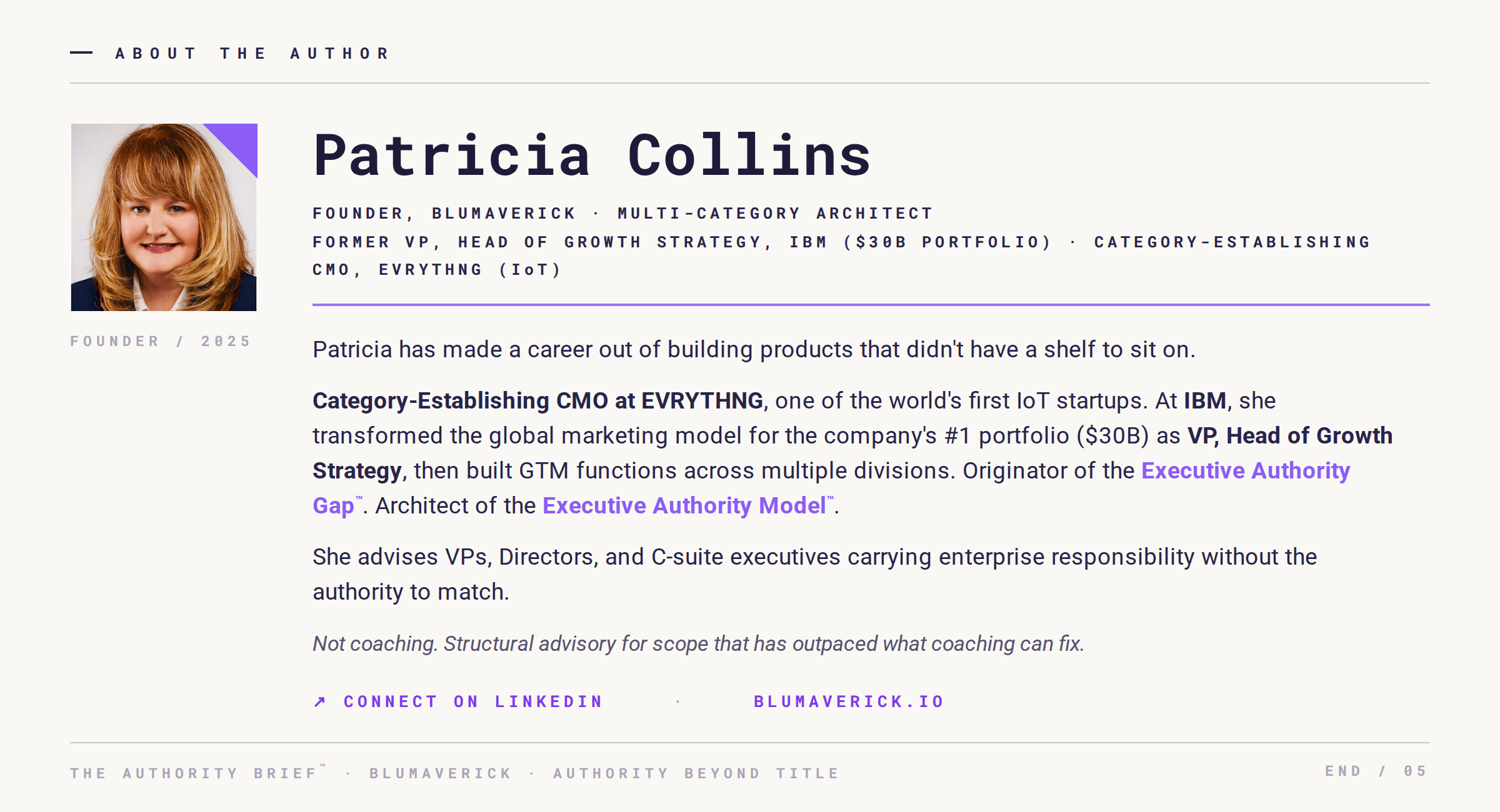
Patricia Collins, Author & Founder
This is not traditional executive coaching. It is structural advisory — for executives whose scope has already outpaced what coaching can't fix.
See also:The AI Authority Gap— when the scope you're accountable for now includes AI you don't control.
Sources: Gartner, share of multinationals using matrix structures, 2024 · Gallup, accountability as lowest‑rated leadership competency, 2026 · People Management / CMI, the management "authority gap," 2025..
Power moves that skip the org chart.
Continue exploring executive authority, structural diagnosis, and the moves that create momentum beyond formal title.
View more Sideways articles →