
Executive Advisor vs. Executive Coach: The Difference When Your Responsibility Outgrows Your Authority
The distinction matters because the problem determines the kind of help you need. If the constraint is inside the executive, coaching can help. If the constraint is in the organizational structure around the executive, the solution has to address the structure.

When your responsibility has outgrown your authority, the constraint may not be you. It may be the Executive Authority Gap™.
Here is how to tell the difference between executive coaching and executive advisory, when each is appropriate, and what can happen when responsibility keeps expanding without the authority to match it.
[Executive Advisor vs Executive Coach banner image]
Every executive I have advised in the last twelve months arrived asking for the same thing: a coach.
Some needed one.
Others needed something the market rarely names: an executive advisor whose work is to examine the organizational structure around the executive when the structure itself has become the problem.
Not a thought partner. Not a mentor. Not a coach with a sharper voice.
An advisor examines the conditions that determine whether an executive can actually exercise the responsibility they already carry.
The Difference at a Glance
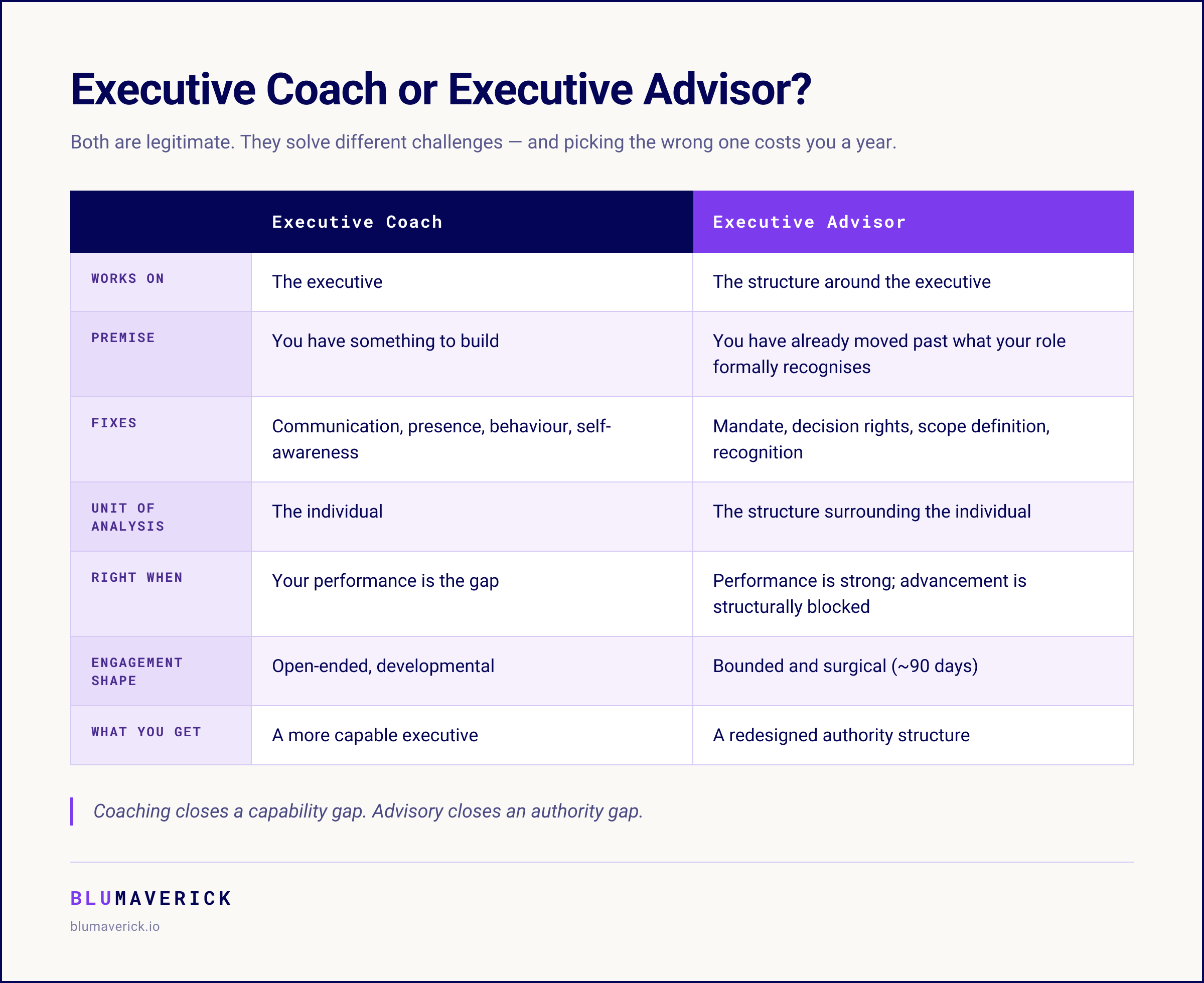
Executive Coach or Executive Advisor
Executive Coach
Works primarily with the executive's:
behavior
thinking
self-awareness
communication
executive presence and capabilities
Executive Advisor
Works with the conditions around the executive:
formal authority
decision rights
organizational positioning
cross-functional authority
recognition
You would not ask a tax advisor to process grief.
You would not ask a therapist to file a return.
Yet the executive market has largely settled on one category of help as the answer to almost every executive problem.
The question is not whether coaching is valuable.
It is whether the constraint is inside the executive or in the structure around them.
Not sure which you need?
Map your gap in 60 seconds with the Executive Authority Gap™ Checklist. → MAP YOUR GAP
Responsibility Without Authority Has a Structural Name
The condition already has a common name: responsibility without authority.
You are accountable for outcomes you cannot fully authorize.
The conventional response is usually behavioral:
Influence better. Build the coalition. Manage up.
Those approaches can be useful. But they assume the executive has the authority needed to act and simply needs to exercise it more effectively.
Sometimes that is not the problem.
The Executive Authority Gap™ opens when responsibility scales faster than your formal authority — when decision rights, organizational positioning, title, compensation, or recognition lag behind the work actually being performed.
That Changes the Question
Not: How does this executive develop further?
But: What structural conditions are limiting this executive that personal development cannot fix?
The data points in the same direction.
73% of workers say they have been asked to do work above their position, while 78% carry larger workloads without additional compensation.
And when organizations diagnose why senior hires miss expectations, only 15% of failures are attributed to skill, while 68% are attributed to politics, mandate, peer dynamics, and cultural alignment.
Some executive performance problems are not capability problems.
They are context problems.
What It Looks Like by Role
The pattern varies by executive role.
The Revenue Operations Executive
The RevOps executive may be accountable for the go-to-market system and make critical technology or process decisions while the functions consuming that infrastructure sit outside their formal authority.
They own the outcome without necessarily controlling the system producing it.
The Marketing Executive
The CMO presents the revenue strategy to the board while the tools, channels, data, and other mechanisms producing those results may have been selected elsewhere.
The narrative authority is theirs.
The structural authority over everything producing the narrative may not be.
The gap often appears at the org boundaries: between functions, between levels of the organization, between accountability and decision rights, or between the work an executive performs and the role the organization formally recognizes.
Where AI Fits
AI did not create the Executive Authority Gap. It is accelerating it.
Gartner has projected that roughly 20% of organizations will use AI to eliminate more than half of current middle-management positions by 2026.
As organizational layers compress, decisions and accountability can move upward — often toward the executive most capable of absorbing them.
But responsibility can move faster than formal authority.
When that responsibility includes AI, the executive did not choose and cannot govern, the problem becomes particularly visible.
That is the AI Authority Gap™.
Same structural problem. Shorter timeline.
What Executive Coaching Is — and Is Not
At its best, executive coaching is a behavioral discipline.
A coach surfaces blind spots, supports skill development, and helps the executive examine how they think, communicate, and operate.
For a Director moving into a first VP role, coaching can be exactly right.
It can also be valuable for an experienced executive working through communication, presence, interpersonal dynamics, or other individual-level constraints.
But consider a different situation.
You are already performing at a high level.
Your responsibilities have expanded. Other executives rely on you for decisions and outcomes. Yet the formal role, authority, title, or compensation have not caught up.
In that situation, developing the executive further may not address the constraint.
The question becomes structural.
When to Hire Which One
Executive coaching is generally for executives who want to change how they operate. Executive advisory becomes relevant when an executive is already operating at a higher level than the organization has formally authorized or recognized.
Three questions can help.
1. Is the constraint behavioral or structural?
If your performance has been strong for years while your responsibility has expanded beyond your formal role, the limiting factor may not be skill.
It may be authority.
2. Why does the decision stall?
Because you do not know what to do?
Or because you lack the formal authority to act?
Those are fundamentally different problems.
3. Has anyone told you this?
"You're doing the executive job. We just haven't formalized it yet."
That sentence deserves scrutiny.
It can describe an organization already benefiting from executive-level work without redesigning the role around it.
Coaching is the right tool when the constraint is inside the executive.
Structural executive advisory becomes relevant when the constraint is in the organization around them.
That may look like:
responsibility exceeding formal authority
decisions stalling because authority is unclear or absent
critical cross-functional dependencies sitting outside the executive's control
a role being described in language calibrated to a smaller job
accountability increasing without corresponding decision rights or recognition
This is why I created Blumaverick because I experienced this gap myself — carrying responsibility at a level that exceeded my formal authority, title, and organizational structure. I built the advisory model I wish I had when I was navigating it, so executives can identify what needs to change.
How Does an Executive Advisor Close the Gap?
An executive advisor does not start by asking the executive to change their behavior.
The work starts by examining the structure around the role:
What are you actually responsible for?
What decisions can you make without escalation?
Where does authority stop?
Which critical dependencies sit outside your control?
How is your role positioned relative to peers and senior executives?
Does your title, compensation, and organizational recognition reflect the work you are already performing?
From there, the advisor determines what needs to change.
That may mean clarifying decision making, redesigning organizational structure, and formalizing authority.
The objective is not to make the executive better at carrying an impossible structure. It is to determine whether the structure itself needs to change.
Blumaverick grew from seeing this gap firsthand — in my own experience and in the executives around me who carried responsibility beyond their formal authority, title, and organizational structure. That pattern led to the development of the Executive Authority Method™ — a structured approach to identifying where the structure needs to change.
The Cost of Staying in the Gap
The longer responsibility exceeds authority, the more expensive the gap becomes for you.
There is an expectation that you will continue delivering at the level of responsibility you have assumed — even when the authority, compensation, and recognition to support it have not followed.
You compensate for missing structure with personal effort: more influence, more escalation, more hours. You pay the bandwidth tax in time, energy, compensation, strategic capacity, and mental exhaustion — while the company continues to capture the value without bearing the cost of the gap.
Over time, that compensation becomes invisible. The organization begins to depend on you to absorb what the structure has not resolved. And when you push back on taking on more, the response can be: “That’s your job.” Even when the responsibility was never part of the role, the expectation has become normalized.
Meanwhile, your career can lose momentum.
Your role expands without your title. Your responsibility increases without your authority. Your contribution grows while compensation stays flat and recognition fails to catch up.
What begins as a temporary stretch can become a role that has structurally outgrown itself.
The risk isn’t simply burnout.
It is career erosion — becoming indispensable to the current structure while becoming increasingly difficult to advance within it.
That is why identifying the Executive Authority Gap™ early matters.
Frequently Asked Questions
Is this just executive coaching by another name?
No.
Executive coaching develops the executive. Structural executive advisory examines the conditions around the executive — including authority, decision rights, organizational positioning, and recognition.
I already have a coach. How do I know if I need an advisor too?
Ask a simple question: Is the remaining constraint behavioral or structural?
If you're performing well, your responsibilities have expanded beyond your formal role, and decisions are stalling because authority or organizational structure is unclear, coaching may not be the constraint. The structure may be.
Next Step
Don't spend another year compensating for a structural gap.
Find out where your responsibility and authority have separated — and what the gap may be costing you.
60 seconds. No sign-up. No obligation.

About the Author: Patricia Collins
SOURCES
1. JobSage — Employee Experience Statistics 2023 — https://www.jobsage.com/employers/employee-experience-statistics-to-know-in-2023/
2. McKinsey — Leadership transition failure data — referenced research on ~50% transition failure rate
3. McKinsey — Untangling Your Organization’s Decision Making — https://www.mckinsey.com/capabilities/people-and-organizational-performance/our-insights/untangling-your-organizations-decision-making
4. Gartner — Top Predictions for IT Organizations and Users in 2025 and Beyond (October 2024) — https://www.gartner.com/en/newsroom/press-releases/2024-10-22-gartner-unveils-top-predictions-for-it-organizations-and-users-in-2025-and-beyond
5. Institute of Executive Development + Alexcel — Senior leadership transition study (executives in top 5% of organisations, 12 countries, 21 industries)
6. McDermott, Levenson, Newton (2007) — Evaluating the effectiveness of executive coaching: Beyond ROI?
7. BTS — Why executive transitions go wrong — https://bts.com/insights/executive-transition-failure-causes-solutions/
8. DDI — Why Executive Transitions Continue to Fail — https://www.ddi.com/blog/executive-transitions
9. Capterra — Middle Manager Burnout — https://www.capterra.com/resources/middle-manager-burnout-strategies/
Power moves that skip the org chart.
Continue exploring executive authority, structural diagnosis, and the moves that create momentum beyond formal title.
View more Sideways articles →