
Perception Lag: Why High Performers Get Passed Over For Less Capable Peers
There is a pattern almost every overdelivering VP and Director eventually runs into, and almost no one names correctly.
You are doing the bigger job. Everyone seems to know it. And someone with a weaker track record gets the title.
The usual explanations arrive on cue. You need more visibility. You need to manage up better. You need executive presence. You need to play the politics. Each explanation locates the problem inside you — and each one is aimed at the wrong thing. And in a year when AI is reshaping org charts faster than HR cycles can document them, the misdiagnosis is getting more expensive, because the gap it describes is widening by the quarter.
The real reason is structural, and it has a name. It is Perception Lag — the single most common reason capable people are passed over while less capable peers are promoted, and one of the core mechanisms inside the Executive Authority Gap™.
Perception Lag
The Definition
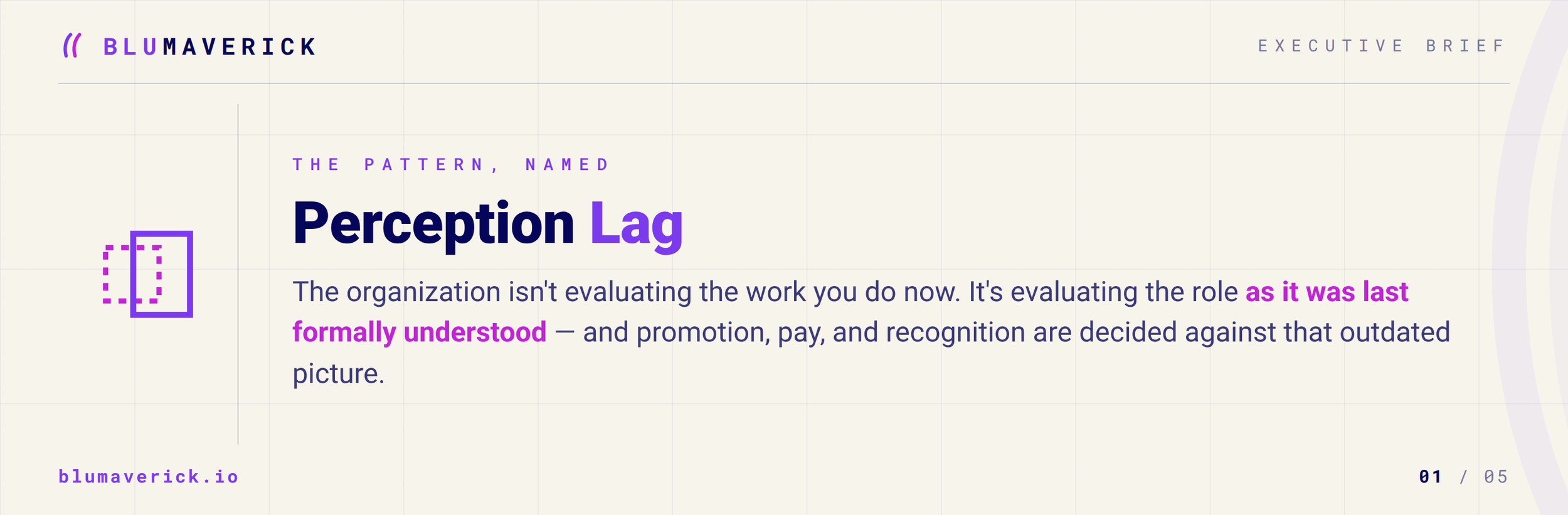
Perception Lag aka Responsibility without Authority is the structural condition where an organisation's understanding of a role still reflects an earlier, smaller version of it, while the executive's actual scope has moved far beyond that definition.
The organisation is not evaluating the work the executive does now. It is evaluating the role as it was last formally understood — and promotion, compensation, and recognition decisions are made against that outdated picture, not against present reality.
What It Is — a Gap Between Two Descriptions
Perception Lag is the distance between two descriptions of the same role: the one the organisation carries in its head, and the one the work actually requires today.
The executive can see the second description clearly. They live inside it. They know exactly how much responsibilty has expanded. The organisation, by contrast, updates its model only at formal inflection points — promotions, reorganisations, role redesigns. Absent those signals, it defaults to the most recent formal definition it has on file.
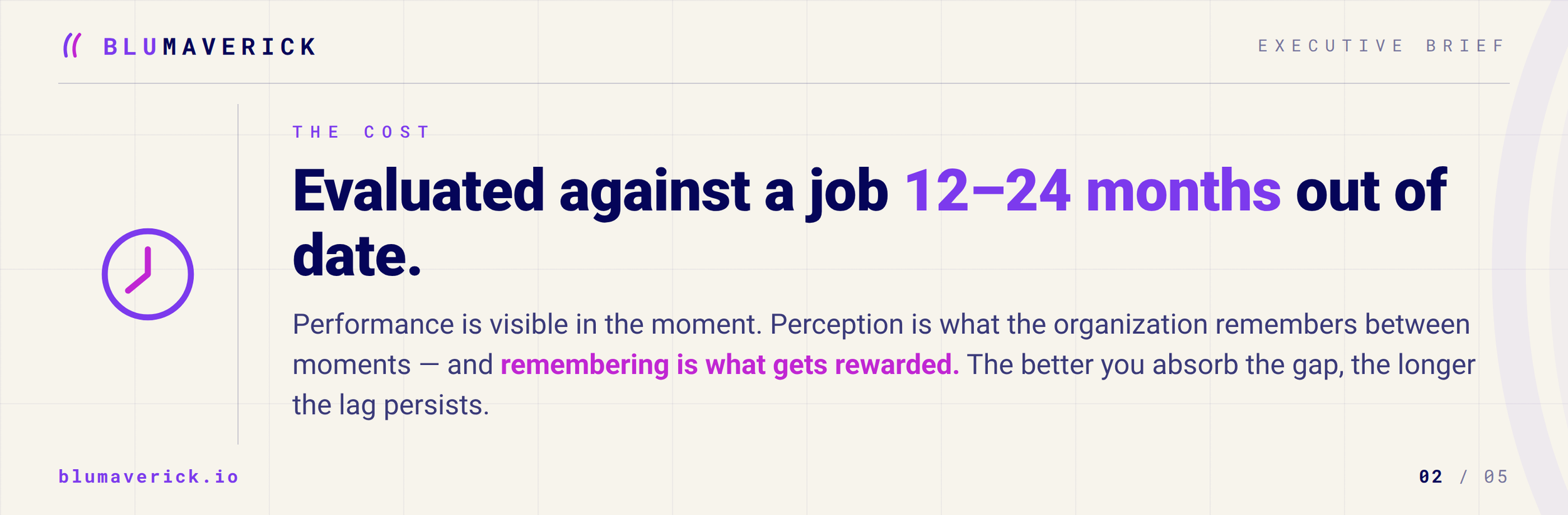
So the executive is evaluated against a stored model that is twelve, eighteen, twenty-four months out of date — and no amount of present performance touches the stored model directly.
Evaluated against a job 12-24 months out of date
Why Performance Hides It
The cruel mechanism of Perception Lag is that competence makes it worse.
The more reliably an executive holds expanded scope together, the less the organisation is forced to notice the scope changed at all. Smooth delivery removes the very friction that would have signalled a structural change. Performance, in other words, is what hid the lag in the first place — which is exactly why more performance never closes it. You cannot out-deliver a perception problem; delivering harder only deepens the impression that the current arrangement is working fine.
You are likely living in Perception Lag
Why AI Is Widening the Lag Right Now
AI-driven org redesign is widening Perception Lag as we speak.
Gartner projects that around 20% of organisations will use AI to eliminate more than half of current middle-management positions by 2026 (Gartner). Flattening expands VP and Director scope almost overnight, while titles and formal definitions still move at the speed of HR cycles. The faster scope grows, the wider the lag — and the more capable people get passed over for reasons that have nothing to do with capability. This AI-accelerated version of the condition is what we call the AI Authority Gap™: the same structural lag, compressed into quarters instead of years.
Who Experiences It Most Acutely
High performers who absorb quietly. The more reliably they hold expanded scope together, the less the organisation is forced to notice the scope changed. Their competence is what keeps the lag invisible.
Senior women. Research from McKinsey, Yale, and others has consistently documented that women's contributions are more likely to be attributed elsewhere and recognised later. Perception Lag is the structural mechanism underneath that pattern — and as formal diversity structures are dismantled across many organisations, the informal recognition that might have closed the lag becomes even less reliable.
Newly promoted executives. The title moved, but perception, decision rights, and the political map did not. The first 90 days feel structurally impossible because the organisation is still relating to the previous occupant of the role.
How to Know You're in It
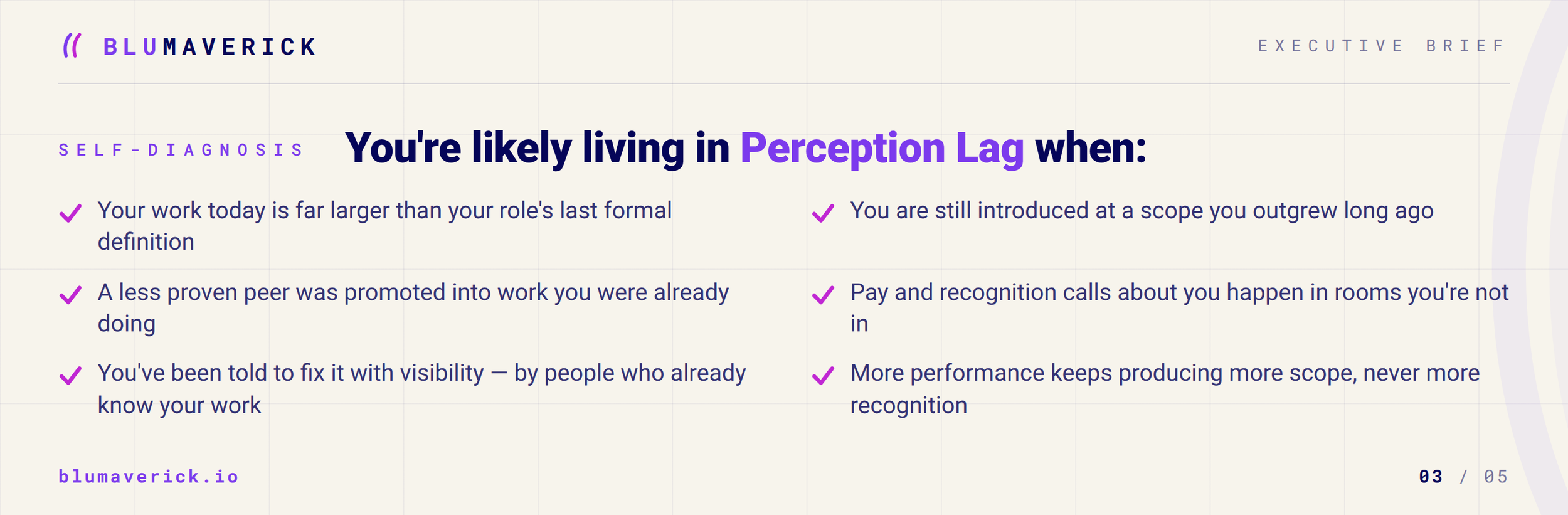
Six questions. The more that describe your situation, the more pronounced your Perception Lag.
One — Is the work you do today materially larger than the last formal definition of your role?
Two — Are you still introduced or described at a scope you outgrew 12 to 24 months ago?
Three — Do peers refer to you as if you held a higher title than you formally do?
Four — Has a less proven peer been promoted into work you were already doing?
Five — Are recognition and pay decisions about you made in rooms you are not in?
Six — Have you been told to fix it with more visibility — when the people deciding already know what you do?
If three or more describe your situation, you are likely being evaluated against an outdated version of your own role.
Why Naming It Matters
Without a name, the passed-over executive concludes the problem is personal. I must not have managed up well enough. I must need more presence. I must have played it wrong. That conclusion sends capable people into a loop of self-correction aimed at a problem that was never inside them.
Naming Perception Lag relocates it. The issue is not that the executive failed to be impressive — it is that the organisation's model of the role never updated. That is a structural condition operating around the person, and structural conditions are redesigned, not out-performed. Once you can name it, the question stops being how do I get noticed and becomes how does the organisation's perception of my role get deliberately updated to match what I run.
How It Gets Closed
Perception Lag does not close on its own, and it does not close through more performance — performance is what hid it in the first place. It closes when the organisation's understanding of the role is deliberately reset.
It's structural, not personal. You've been title stacked — marketing officer, growth architect, now governance owner for every AI system in the funnel. Each added real value. None came with a decision right, and your comp is still priced against the first one. Blumaverick redesigns it through the Executive Authority Method™.
In a 2026 operating model, resetting perception on purpose is the fastest-closing window in the work — because AI is widening the lag faster than any organisation will close it by accident.
Two Steps Forward
Start with the 60-second BluShift Authority Gap Checklist to see where your accountability has outrun your authority→
→ See how the Executive Authority Method™works.
Q: I keep being told to be more visible, but the people deciding already know my work. Why isn't that landing?
A: Because visibility addresses attention, and your problem is the stored model the organisation evaluates you against — which more attention does not rewrite. When decision-makers already know your work and still pass you over, the cause is a role definition that never updated, not a recognition deficit. That is Perception Lag, and the fix is a deliberate reset of the signals that carry perception.
Q: How is Perception Lag different from just office politics?
A: Politics is about relationships and competing interests; Perception Lag is about an outdated formal model of your role that operates regardless of who likes you. The tell is consistency — if you are evaluated at your old scope predictably, across different stakeholders and rooms, it is structural rather than personal, and it sits inside the Executive Authority Gap™.
Q: What's the first step to resetting the model?
A: Establish how far your real scope has moved beyond your role's last formal definition, and which decision rooms still run on the old one. The Authority Gap Checklist is built for exactly this — and it locates the lag before any reset begins.
Blumaverick · Responsibility without Authority · blumaverick.io

About the Author: Patricia Collins
SOURCES
Gartner, Top Predictions for IT Organizations and Users in 2025 and Beyond — https://www.gartner.com/en/newsroom/press-releases/2024-10-22-gartner-unveils-top-predictions-for-it-organizations-and-users-in-2025-and-beyond
LeanIn.Org & McKinsey & Company, Women in the Workplace (annual study, 2015–2025). womenintheworkplace.com / mckinsey.com/featured-insights/diversity-and-inclusion/women-in-the-workplace
Moss-Racusin, C. A., Dovidio, J. F., Brescoll, V. L., Graham, M. J., & Handelsman, J. (2012). "Science faculty's subtle gender biases favor male students." Proceedings of the National Academy of Sciences, 109(41). doi.org/10.1073/pnas.1211286109
Botelho, T. L., & Abraham, M. (2017). "Pursuing Quality: How Search Costs and Uncertainty Magnify Gender-based Double Standards in a Multistage Evaluation Process." Administrative Science Quarterly, 62(4). Yale School of Management.
Ross, M. B., Glennon, B. M., Murciano-Goroff, R., Berkes, E. G., Weinberg, B. A., & Lane, J. I. (2022). "Women are credited less in science than men." Nature, 608. doi.org/10.1038/s41586-022-04966-w
Sarsons, H. (2017). "Recognition for Group Work: Gender Differences in Academia." American Economic Review: Papers & Proceedings, 107(5).
Heilman, M. E., & Haynes, M. C. (2005). "No Credit Where Credit Is Due: Attributional Rationalization of Women's Success in Male-Female Teams." Journal of Applied Psychology, 90(5).
Power moves that skip the org chart.
Continue exploring executive authority, structural diagnosis, and the moves that create momentum beyond formal title.
View more Sideways articles →