
The Quiet Derailment: How High Performers Get Sidetracked — and What It Actually Costs
Byline: Patricia Collins · Founder, Blumaverick · Category-Establishing IoT CMO · ex-IBM VP, Head of Growth Strategy ($30B Cloud)
Consider a number: 1 in 4.
That is the share of mid-career professionals who have gone five or more years without a promotion or meaningful raise — still employed, still delivering, but structurally stalled. Not a rounding error. Not an outlier group. One in four.
This is the central finding of Sidetracked: The Hidden Crisis in Mid-Career Mobility, published June 2, 2026, by the NYU School of Professional Studies and the Burning Glass Institute, drawing on 25 years of career histories across 1.3 million professionals. The researchers named it precisely: not unemployment, but a loss of momentum inside employment.
If you recognize yourself in that number — or suspect you're close to it — this is worth your full attention.
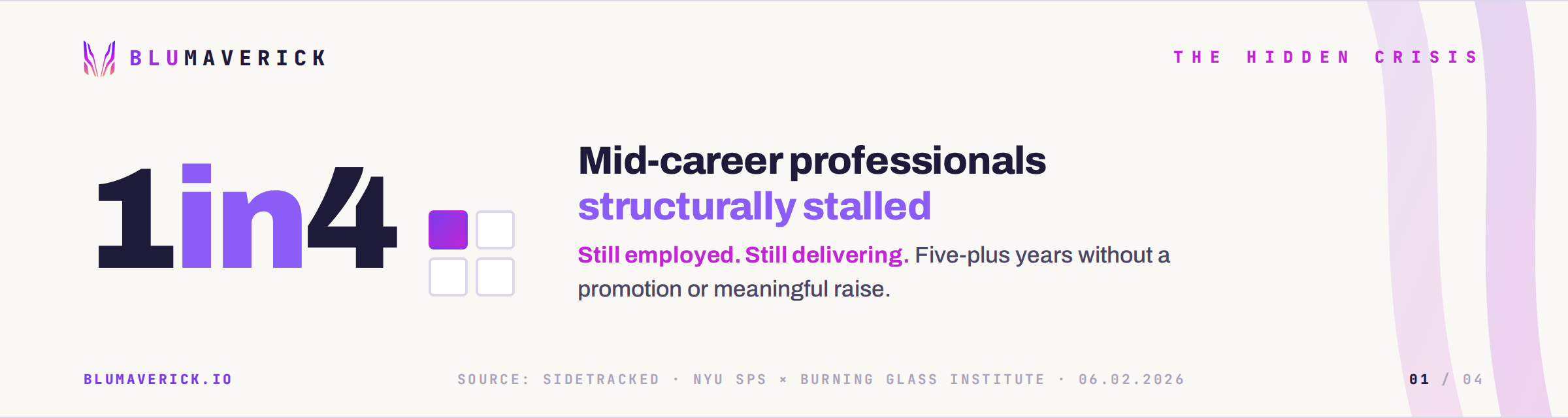
1 in 4 mid-career professionals stalled 5+ years without promotion or meaningful raise — Sidetracked study, NYU and Burning Glass Institute, 2026
This Is Not a Performance Problem
The instinct is to look inward. To wonder what you missed, what you didn't do, who you didn't impress. That instinct is understandable, and it is wrong.
The Sidetracked research is unambiguous: mid-career stall is a structural phenomenon, not an individual failure. Organizations have flattened. Internal mobility pathways have narrowed. The architecture that once moved high performers upward — through visible roles, sequenced advancement, and systematic exposure to decision-makers — has quietly contracted.
What remained constant is output. Executives in stall are still delivering. The problem is not performance. The problem is that performance is no longer automatically converting into advancement.
Not sure if you're in the window? Blumaverick's Authority Roadmap maps where your gap is widest and what to move first — so you can scale yourself, not just your output. Send a message with the word AUTHORITY and I'll send it to you directly.
The Financial Penalty Is Larger Than You Think
There is a temptation to treat stall as a career inconvenience — a plateau, not a crisis. The data does not support that framing.
For a software developer, the cumulative wage deficit from mid-career stall exceeds $43,000 over 15 years compared to peers who continue advancing. Compound that across total compensation: missed equity, deferred retirement contributions, lower bonus bases, and the compounding effect of raises never received.
And organizations are noticing the downstream damage. According to the Payscale 2025 Compensation Best Practices Report, 31% of organizations cite perception of unfair pay as a primary reason they are losing talent — up from 21% the prior year. The gap between what high performers are worth and what they are being paid is becoming impossible to obscure.
This is not a personal setback. It is a structural tax on expertise.
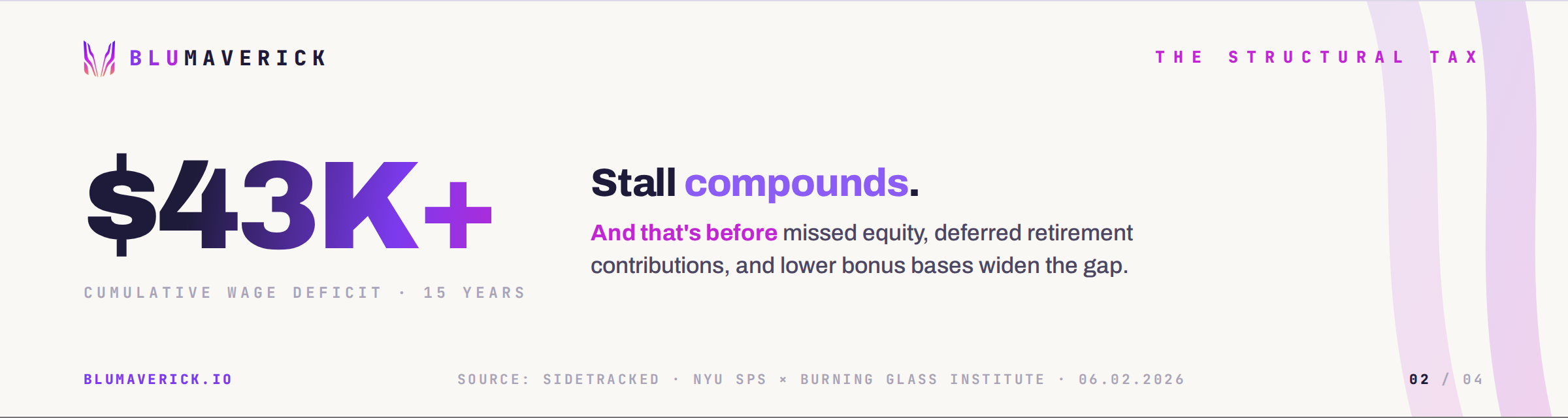
$43,000+ cumulative 15-year wage deficit from mid-career stall, before missed equity and bonuses compound the gap — Sidetracked study, NYU and Burning Glass Institute, 2026
The Real Variable: Authority Architecture
If performance isn't the problem, what is?
The research points to visibility and momentum. Those who avoid stall average 1.9 promotions and 66% wage growth at the ten-year mark. Those who stall average 1.5 promotions and 45% wage growth at the same point. The divergence is not dramatic — it is incremental, structural, and self-reinforcing.
What separates the two trajectories is not talent. It is how that talent is positioned, perceived, and legible to the people making advancement decisions.
Blumaverick defines this as the Executive Authority Gap™ — the distance between how much authority a professional has earned and how much institutional authority they actually hold. The gap is real, it is measurable, and crucially, it is closeable. But it does not close on its own, and it does not close through harder work alone. It closes when the architecture of executive presence, positioning, and organizational visibility is built deliberately — with the same strategic intentionality applied to any other business problem.
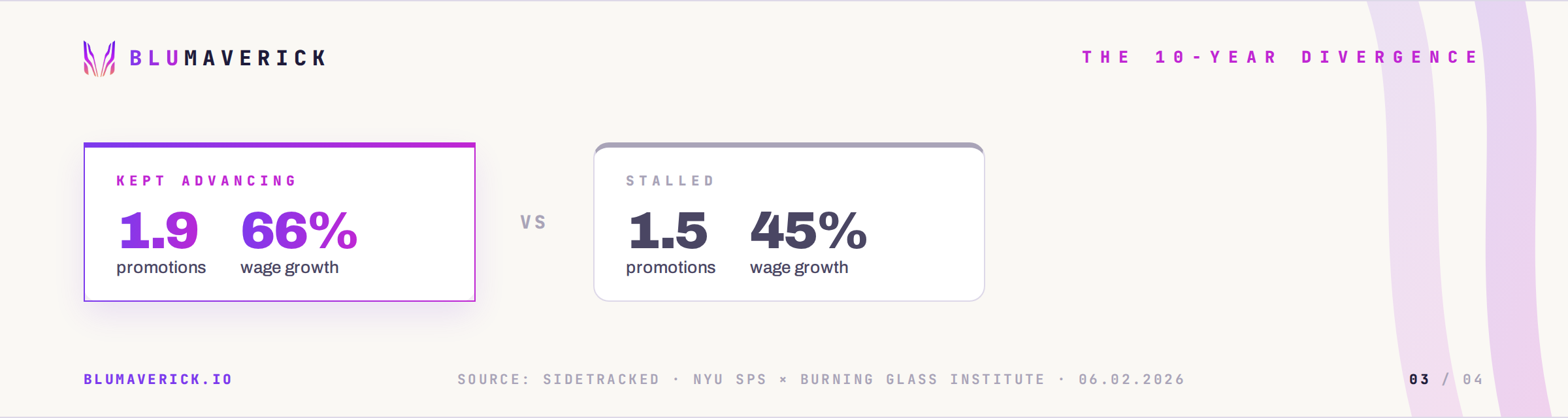
Career divergence at the 10-year mark: advancing professionals average 1.9 promotions and 66% wage growth vs 1.5 promotions and 45% for those who stall — Sidetracked study, NYU and Burning Glass Institute, 2026
The Forward Obligation
The Sidetracked report offers something rare in workforce research: precision about when intervention becomes possible. The researchers are explicit — stall is not a sudden rupture. It is a slow-moving pattern that becomes visible well before it becomes entrenched.
The researchers themselves are clear: "The stall isn't one singular event — it's a bunch of small structural warning signs that show up much earlier than the event happens."
In advisory practice, the pattern is consistent. The signal begins around the 12-month mark — subtle enough to rationalize as an organizational cycle or budget constraint. By 18 months, it has reached its inflection point: the deceleration is no longer ambiguous, but it still hasn't been named. That window between recognition and response is where trajectory is decided.
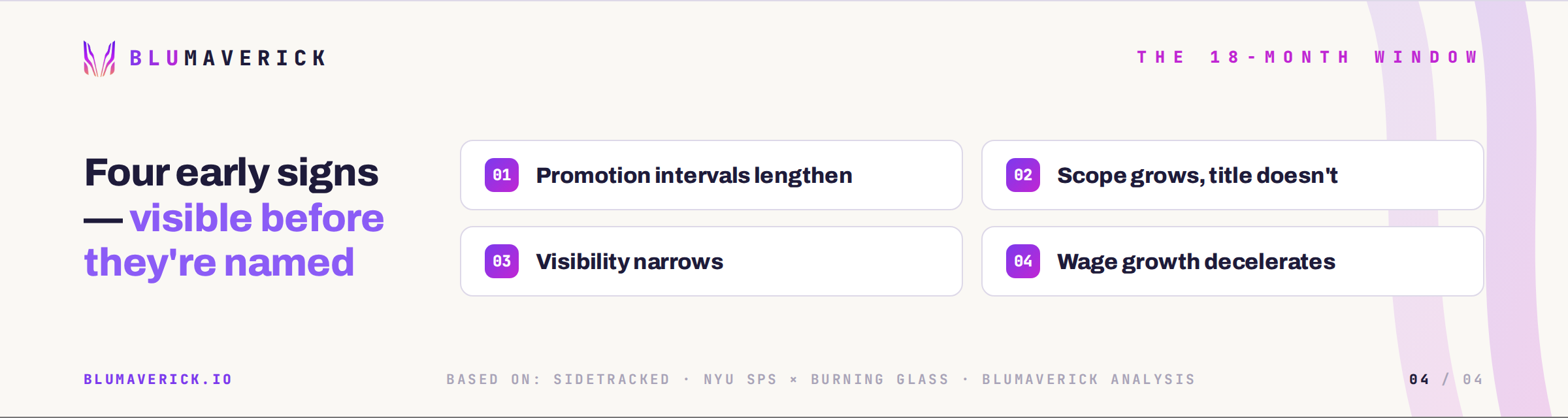
Four early warning signs of mid-career stall: promotion intervals lengthen, scope grows without title, visibility narrows, wage growth decelerates — Blumaverick analysis of the Sidetracked study, 2026
What the early pattern looks like:
· Promotion intervals lengthen. What used to move in 18-month cycles starts stretching to three years, then longer — with no structural explanation and no clear criteria for what would change it.
· Scope expands, title doesn't. Responsibilities grow — new teams, larger mandates, cross-functional accountability — but the organizational chart doesn't move. The work is C-suite. The recognition isn't.
· Visibility narrows. Access to key decision-makers becomes mediated. The executive is doing the work but is no longer in the rooms where advancement decisions are made.
· Wage growth decelerates. Annual increases track inflation, not contribution. The raise reflects tenure, not trajectory.
By the ten-year career mark, those who ultimately stall have already fallen behind — averaging just 1.5 promotions and 45% wage growth compared to 1.9 promotions and 66% growth among peers who continue advancing. The divergence began earlier. It just wasn't named.
For executives at the VP, Director, or C-suite level who recognize this pattern, the question is not whether the problem exists. The data settled that. The question is whether the response will be individual and improvisational — or structural and deliberate.
High performers who have spent years building organizational value deserve a strategy equal to what they have built.
The framework exists. The path is not personal reinvention — it is architectural correction.
For executives ready to close the gap, two moves matter most:
· Map where the gap is widest. Stall accelerates when executives don't have a precise read on where their authority, visibility, and positioning have diverged from their actual scope of contribution. That diagnosis has to come before any strategy.
· Rebuild the architecture deliberately. Advancement at the VP, Director, and C-suite level is not a performance review outcome — it is a positioning and mandate problem. It requires the same structural rigor applied to any business challenge: clear diagnosis, defined leverage points, and a sequenced plan.
Blumaverick works with executives at exactly this inflection point — not to reinvent who they are, but to scale themselves: aligning what they've built with how the organization sees, rewards, and advances them.
If you recognize the pattern, the first step is a clear path forward — so you can scale yourself, not just your output. Get your Authority Roadmap →

Published by Blumaverick | Structural Executive Advisory
Sources: Sidetracked: The Hidden Crisis in Mid-Career Mobility, NYU School of Professional Studies and Burning Glass Institute, June 2, 2026. Payscale 2025 Compensation Best Practices Report, March 12, 2025.
Power moves that skip the org chart.
Continue exploring executive authority, structural diagnosis, and the moves that create momentum beyond formal title.
View more Sideways articles →