
Why Executives Get Stuck Between VP and C-Suite
When to Reevaluate Your Role at the Executive Level
Most executives don't stall because they stop performing.
They stall because their role stops evolving around them.
You take on more scope. More accountability. More cross-functional complexity. But your formal authority doesn't move with it. Your decision rights stay the same. Your title stays the same.
And the organization keeps evaluating you at the level you were — not the level you're
operating at.
That's not a performance problem. That's a structural one.
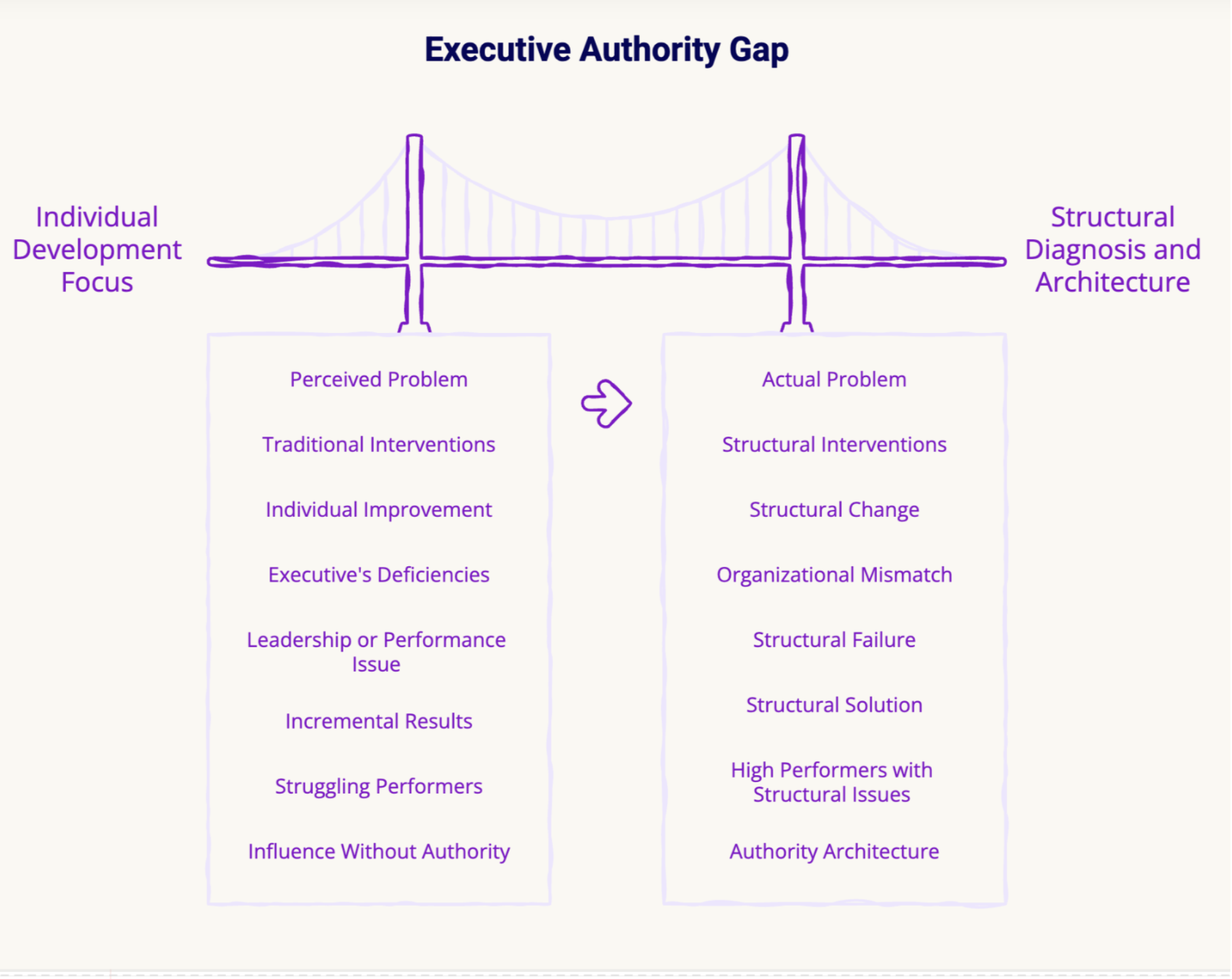
Executive Authority Gap™
What's actually happening
You're already doing the executive job. The organization just hasn't built the structure
around you to reflect it.
You're accountable for outcomes you don't fully control. You're shaping decisions you're not in the room to make. You're the person leadership calls first — and the person who still doesn't have the formal authority to match what you're carrying.
From the outside it looks like growth. Inside, nothing moves.
Why working harder doesn't fix it
More output won't close this gap. Neither will more visibility, more presence, or another high-visibility project.
The leaders who stay stuck longest are usually the ones delivering the most. Because their
reliability makes the structural problem invisible — to the organization and sometimes
to themselves.
When you absorb the gap, the gap disappears. Not for you. For them.
The escalations stop surfacing. The friction stops showing up in reports. Leadership sees
smooth execution and has no signal that anything needs to change.
Your performance is solving their architecture problem. For free.
The signs your role has outgrown its structure
You don't need to wait for a formal review to know something is off. These are the signals
worth paying attention to:
You're accountable for outcomes but not part of the decisions behind them. Your scope has expanded but your authority hasn't moved with it. You're operating across functions without clear ownership. You're consistently told you're almost ready — but not advancing.
Each of these is a structural signal, not a performance one. They're telling you exactly
where the gap lives.
What the authority gap actually costs
This isn't just a career frustration. It compounds.
Every quarter the gap exists, your scope grows and your formal authority falls further behind. The organization becomes more dependent on your informal authority.
Structural recognition falls further out of reach.
Promotion decisions get made based on a version of you the org chart still shows
— not the version actually running the work.
It shows up as friction. Decision ambiguity. Executive fatigue. Being passed over despite
results that should have made the case three cycles ago.
Why it doesn't close on its own
Organizations don't fix structural gaps they can't see. And as long as you're absorbing the
friction, they can't see it.
The authority gap closes by design — not by performance, not by time, and not by waiting
for the organization to catch up on its own.
It requires a structural diagnosis:
Where exactly has your scope outpaced your original responsibility
How the organization currently perceives your role.
Redesign of those three systems so they reflect what you're already accountable for.
That's the work.
If you're doing the work but not being recognized, you're already in the authority gap.
And it does not resolve on its own.
If this is the gap your carrying — this is what Blumaverick was built to solve.
Next Step:
Read the brief. The AI Authority Executive Brief expands this essay — what the gap is, why it's structural, and how it closes. →
OR
Map your gap. Take the 60-second self-serve Executive Authority Gap Checklist now for a fast read on where your responsibility has outrun your title. →

— Patricia Collins, Founder, Blumaverick
Power moves that skip the org chart.
Continue exploring executive authority, structural diagnosis, and the moves that create momentum beyond formal title.
View more Sideways articles →