
I Narrated an AI Strategy I Didn’t Govern
For the CMO who became the face of the company’s AI story — and was never given authority over the systems behind it.
Your org chart says you own marketing. Your board thinks you own the AI.
I sat in the CMO seat and told the board a story about our AI strategy. It was a good story. AI was reshaping our go-to-market, lifting pipeline, sharpening the customer experience. I told it well, because telling it was my job. What I couldn’t see at the time is that I was accountable for results produced by systems I didn’t run. RevOps picked them. IT approved them. Finance paid for them. I governed none of them. I just narrated them.
The condition I didn’t have words for
The CMO has become the face of the company’s AI story. The board asks marketing to explain what AI is doing to pipeline, to spend, to the customer. So you explain it. But the authority over those systems lives in other functions. You narrate the AI. You don’t govern it. The accountability for the story got handed to you. The control over what’s underneath it never did.
That’s not a marketing problem. It’s not “get sharper in the QBR” or “build a better relationship with RevOps.” Those are coaching answers, and I tried them. They don’t move a single decision. The problem is structural: you’re answerable for outcomes you have no authority to change.
And the question under it: are you recognized and paid for owning the company’s AI story — or are you absorbing the blame for systems you were never given the power to run?
What it looked like
Board meeting. The chair turns to me.
"Can you explain why AI-driven campaign efficiency fell this quarter?"
I can. I walk them through the numbers.
Then the second question: "Who approved the model that shifted the spend?"
I pause. Marketing didn't choose it. RevOps configured it. IT approved the integration. Finance signed the contract.
I'm still the one standing at the front of the room.
I owned the slide. I owned the narrative. I owned the answer. I had never owned the decision.
I’ll make it concrete, because it happened. The board asked why a campaign’s return had dropped. The answer was buried in an AI bidding tool that had quietly shifted spend toward the wrong segments. I hadn’t chosen the bidding tool. I couldn’t change how it allocated. But I was the one in the room, so it was my number to defend. I defended a decision I didn’t make, couldn’t fully see, and had no authority to reverse. I left that meeting having “owned it,” which in practice meant having absorbed it.
The pattern repeated. Attribution models I didn’t build. Lead scoring I couldn’t override. A content engine generating at a scale no one was formally accountable for. Each one ran on my narrative and someone else’s authority. When they worked, it was the marketing engine. When they didn’t, it was my name.
Why narrating it makes it worse
Here’s the trap specific to this seat. The better you narrate the AI story, the more the organization assumes you own the AI. Competence at telling it reads as authority over it. So the gap doesn’t shrink as you get better — it grows. Every confident board update, every clean slide, every crisp answer in the all-hands quietly reinforces the assumption that the person explaining the system is the person running it. You build your own accountability with your own fluency. And the day something breaks, no one remembers that you only ever narrated it. They remember that you were the one who always had the answers — right up until you didn’t.
It usually turns on a single question you can’t answer. A regulator, a board member, or a reporter asks something specific — how does the bidding model decide this, who approved that, can you turn it off — and the narrative runs out. You can describe what the AI does. You can’t speak to who governs it, because you don’t. The story that served you for two years ends exactly where your authority ends, and everyone in the room sees the seam at the same time. That seam is the authority gap, in public, with your name on it.
The fear is an accurate read
It turns out this is common enough to measure. When AuditBoard surveyed more than 400 governance, risk, and compliance professionals in 2025, the leading obstacle to AI governance wasn't tooling or expertise — it was a lack of clear ownership, named by 44%, ahead of insufficient internal expertise (39%) and limited resources (34%). Fewer than 15% blamed a lack of tools. Read that as the CMO. The gap you're feeling isn't a personal failure — it's one instance of a named, enterprise-wide pattern: accountability landing on people who were never given clear ownership of the systems they answer for.
The advice all points at you
Get closer to RevOps. Build influence. Tell your story better. Manage up. Every one of those is a fix aimed at the person, not the structure. And none of them changes who can stop the AI bidding tool, or who owns the attribution model, or who carries the risk when the content engine produces something off-brand or non-compliant. You can be the most influential CMO in the building and still be the name on a system you can’t govern.
Here's the number that named it for me, after the fact. In Grant Thornton's 2026 AI Impact Survey of about 950 senior U.S. executives, three in four boards had approved major AI investments, but only 52% had set clear AI governance expectations. When governance is unset and the board wants an answer, the answer is whoever is narrating. That was me. It may be you.
What would have changed it
Not a better relationship. A clear line between the AI results I actually controlled and the ones I was only narrating — with the second list owned, on paper, by the people who run those systems. Not me getting better at owning everything. The opposite: the structure naming what was never mine to own.
That's structural work, not personal work, and it's specific to each company — which is what the Brief is for. It names where your accountability runs past your authority, and what it takes to close it.
What changes when the line is drawn
When the AI results split cleanly into what you control and what you only narrate — and the second list gets a real owner — the change is immediate. You stop defending decisions you didn’t make. You stop absorbing risk you can’t manage. Your board updates get more honest, because you’re speaking only to what you actually govern and pointing to named owners for the rest. And counterintuitively, narrowing what you own makes you more credible, not less. A CMO who can say “I own this, and here’s who owns that” is in a far stronger position than one who quietly owns everything and can govern almost none of it.
The move
If you’re the CMO narrating the AI story right now, here’s the move. In your next board prep, put an owner next to every AI claim you’re about to make. Who runs this system. Who can stop it. Who owns its risk. The claims where the owner is “unclear” or “me, sort of” are the ones you’re absorbing. Naming them in the room is how they stop being yours by default.
Read The AI Authority Brief→
The brief is the foundational read on the AI Authority Gap — where you're accountable for AI outcomes you don't have the authority to govern.
Want a faster read on your own situation first?
The BluShift Authority Checklist→
Just 60 seconds shows where your responsibility has outrun your mandate.
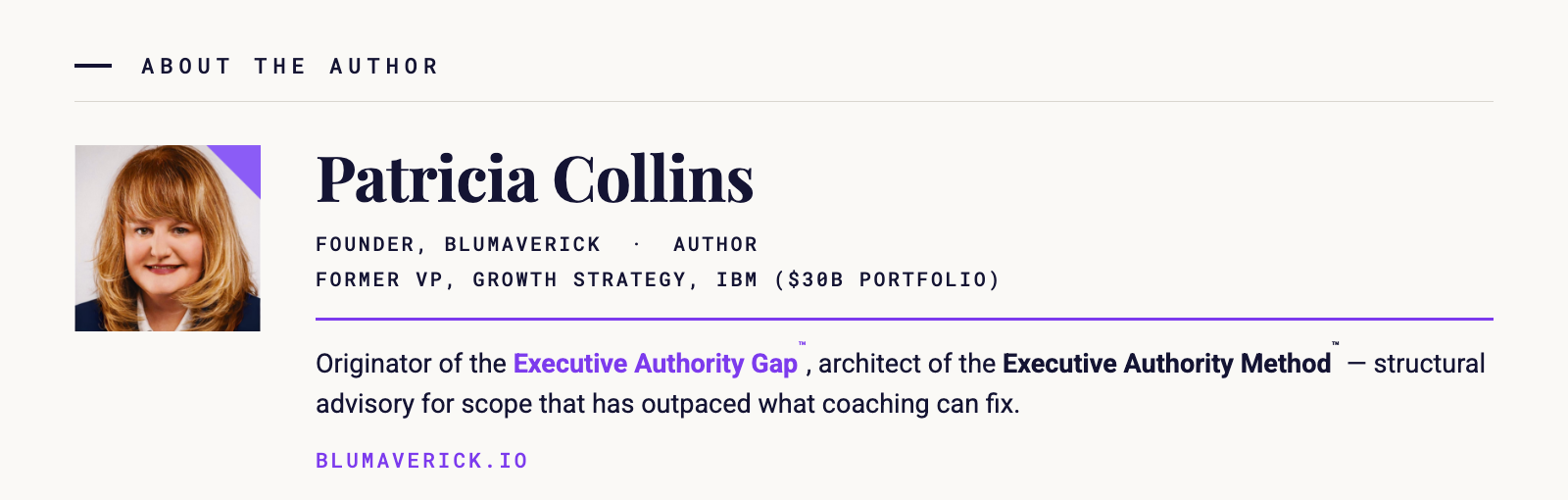
About the Author: Patricia Collins
Source:
Grant Thornton 2026 (control-pain; 52% boards w/ clear AI governance)
Power moves that skip the org chart.
Continue exploring executive authority, structural diagnosis, and the moves that create momentum beyond formal title.
View more Sideways articles →