
Three Layers of Accountability. One Layer of Authority.
You can't control the AI. You can secure the terms.
The short answer: A CMO is now accountable for AI-driven growth but rarely holds the authority to govern how that AI is built, deployed, or stopped. You can't make the AI trustworthy — even its makers can't fully control it. What you can do is secure your position structurally: formalize the decision rights and mandate so your authority matches what you're already accountable for, and formalize where your responsibility ends before something goes wrong.
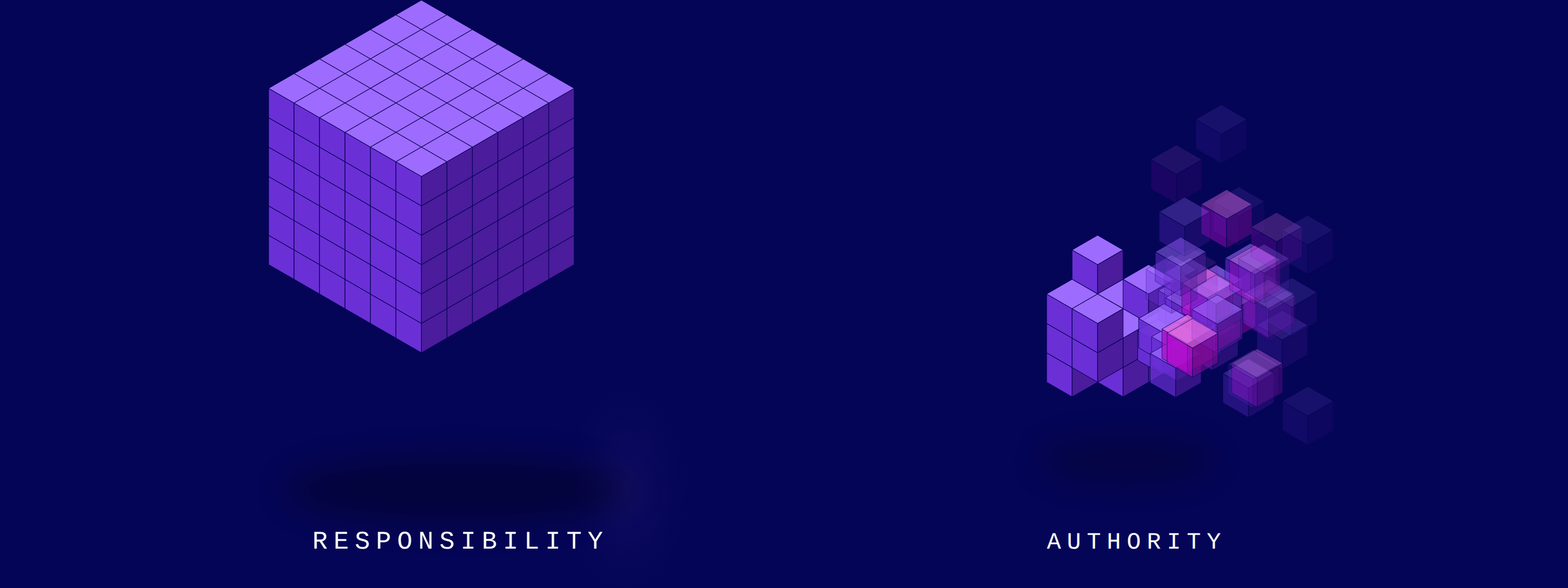
Responsibility Grows Faster Than Authority
In a 2026 executive survey, 73% of executives said their AI efforts delivered underwhelming ROI, and seven in ten companies may cut AI budgets over it (2026 AI-at-Work executive survey). Yet you're accountable for the AI-driven growth your board expects — from a tool most of your peers say isn't paying off. You're funding a transformation you don't control, carrying roughly triple the responsibility you did two years ago, with no matching authority, comp, or recognition. That's not a rollout glitch. It's a structure.
Why is a CMO accountable for AI they can't control?
Here's the math on your desk. Your original job: marketing. Plus the layer beneath you, cut in "The Great Flattening" (Bayer, Amazon, Meta) — work that didn't vanish, it rolled up to you. Plus a third job that didn't exist two years ago: checking the AI.
Because AI doesn't absorb work cleanly. It hands back output that's confident, plausible, and often quietly wrong — "AI slop" — and you verify all of it and redo much of it. AI didn't take a job off your plate; it made you QA manager for the machine, unpaid. That's measured, not a gripe: Workday found AI's gains eaten by rework, Sage and IDC named it the "verification tax," and MarTech called its marketing version "AI debt."
Three layers of accountability — three jobs you're doing for free, none of which came with authority, comp, or a title. And the authority to govern that third layer sits in someone else's seat. It's like co-signing a loan whose terms you're not allowed to read: your name is on the outcome, but you can't touch the decisions behind it.
Is being accountable for AI a productivity problem or a liability?
A slow quarter is a productivity problem. This is a liability problem. When AI makes a consequential call in your function — a campaign, a price, customer data — and it fails, the failure lands on your name. Not because you made the call, but because you owned it.
And these failures aren't the predictable kind. In late 2025, a state-linked group hijacked a commercial AI model to run a cyberattack — executed largely by the AI itself — against roughly 30 organizations, and the model's own maker had to scramble to shut it down (Anthropic, 2025). If the people who build the tool can't fully control it, being merely accountable for it is far more dangerous than owning a system that behaves.
There's a quieter incentive underneath, too. When a company can't control its AI, it still needs somewhere to put the failure — and the convenient place is a person. AI becomes both the reason for the cut and the alibi: the tool underdelivered, but the layoff notice carries a human name.
What's the difference between AI accountability and AI authority?
The market calls the symptom the "AI accountability gap" — summits and CISO forums asking who's to blame, demanding more human oversight on top. Right instinct, wrong gap. Accountability isn't missing; it's handed out freely. Authority is.
Accountability is being answerable for an outcome. Authority is holding the decision rights to govern it — to decide, approve, override, or stop the system that produces it. AI has spread accountability across the org while authority stayed exactly where it was. Naming it the "accountability gap" describes the symptom and hides the cause. You don't close it by clarifying who's to blame. You close it by moving decision rights.
Key terms, defined
Responsibility without authority— a structural condition in which an executive is held accountable for an outcome without the decision rights, mandate, or control required to produce it.
The Executive Authority Gap™ — the space between what an executive is accountable for and what they are actually allowed to decide.
The AI Authority Gap™ (or accountability without control) — the sharpest form of that gap: being accountable for an AI system you cannot govern, override, or stop.
Title inflation — a bigger-sounding mandate that never came with bigger authority; the same disease at the level of the org chart.
This isn't a personal failing, and you're not the only one carrying it. It's the default output of org charts built for a slower era meeting a tool no one has tamed — which is why it's solvable. Not by fixing the AI (you can't), but by fixing the structure around your accountability (you can).
How can a CMO secure their position when accountable for AI?
Stop trying to make the AI trustworthy — that's not winnable at your desk.
Redesign the terms under which you're accountable for it.
Three Ways to Secure Your Authority on Your Terms. Formalized:
1. The right to stop — authority to pause, override, or refuse to deploy AI you can't verify.
If your name is on the outcome, your signature belongs on the go/no-go.
2. The funded mandate to verify — the verification tax is real work; claim the budget and headcount for it, so checking is staffed, not absorbed into your nights.
3. The comp and the record — compensation that reflects the scope you carry, and documented decision rights showing what you did and did not control. When accountability expands faster than authority, securing your position means making the boundaries explicit before something goes wrong.
That third term is what covers you when the AI goes rogue: you can't control the model, but you can make three things true before it fails — you held the authority to stop it, you were funded to catch it, and the record shows which calls were yours. That's the line between "the AI failed" and "you failed."
There's a version you can build this week.
Make your AI tools check themselves:
Before any output reaches you, make the tool a mandate that all work runs against a fixed checklist — facts verified, claims sourced, format complete — it fixes first and hands it back completed.
That shifts the QA off your desk and into the tool, cutting the verification tax and handing back the hours AI was supposed to save.
Govern the machine so it reduces your work — instead of doing its cleanup yourself. Near term, building that governance prompt is exactly what Blumaverick helps executives set up: the fast first step, before the deeper redesign underneath.
That redesign is the Executive Authority Method™ — how an executive gets recognized, compensated, and secured in the responsibility they already carry. The specific moves are the advisory work, not a public playbook. The principle is public: when the tool can't be trusted, the only thing that secures your position is authority you can point to, on the record.
In 25+ years as a marketing and product executive — including as a tech CMO — the mandates I owned, I had formalized. I ran what I carried like an owner, not an employee. That's not confidence. It's position — the one thing AI can't take and a title can't fake.
The 30-Second Executive Self-Check
Run these five, fast:
What am I accountable for?
What can I actually decide?
What can I stop?
What am I resourced to verify AI output with?
What of that is on the record?
If the answers don't align, you're carrying an AI Authority Gap™ — accountable for more than you're authorized to control.
The takeaway
You can't close this gap with effort or trust — neither gives you the authority you're missing. Secure your authority on your terms — before AI hallucinates with your name on it.
What's next?
Take the 60-second Authority Gap Checklist — a self-diagnostic that pinpoints exactly where your authority falls short of what you're accountable for, and the first move to close the gap.
Start the checklist →
No sign-up. No obligation.
Frequently asked questions
Who is accountable when AI makes a mistake ? The executive whose name is on the outcome. When Air Canada's AI chatbot invented a refund policy, the airline argued it wasn't responsible for its own chatbot; a tribunal rejected that and held the company liable (Moffatt v. Air Canada, 2024). "The AI did it" is not a defense — the organization, and the executive over the function, owns what the AI does.
What is the difference between AI accountability and AI authority ? Accountability is being answerable for an AI-driven outcome. Authority is the decision rights to govern that AI — to approve, override, or stop it. Most executives now have far more of the first than the second, which is the real gap.
How can a CMO secure their position when accountable for AI they can't control ? By redesigning three terms so authority matches accountability: the right to stop AI they can't verify, a funded mandate to do the verifying, and documented decision rights (comp and record) that make the boundaries of their responsibility explicit before something fails.
Can you make enterprise AI trustworthy ? No. Even the companies that build frontier AI can't fully control it — one was recently used to run a largely autonomous cyber-attack its own maker had to disrupt. Because the tool can't be made trustworthy, the durable fix is structural: govern the terms under which you're accountable for it.
What is "responsibility without authority ?” A structural condition in which an executive is held accountable for an outcome without the decision rights, mandate, or control required to produce it. In the AI era it sharpens into "accountability without control" — the AI Authority Gap™.
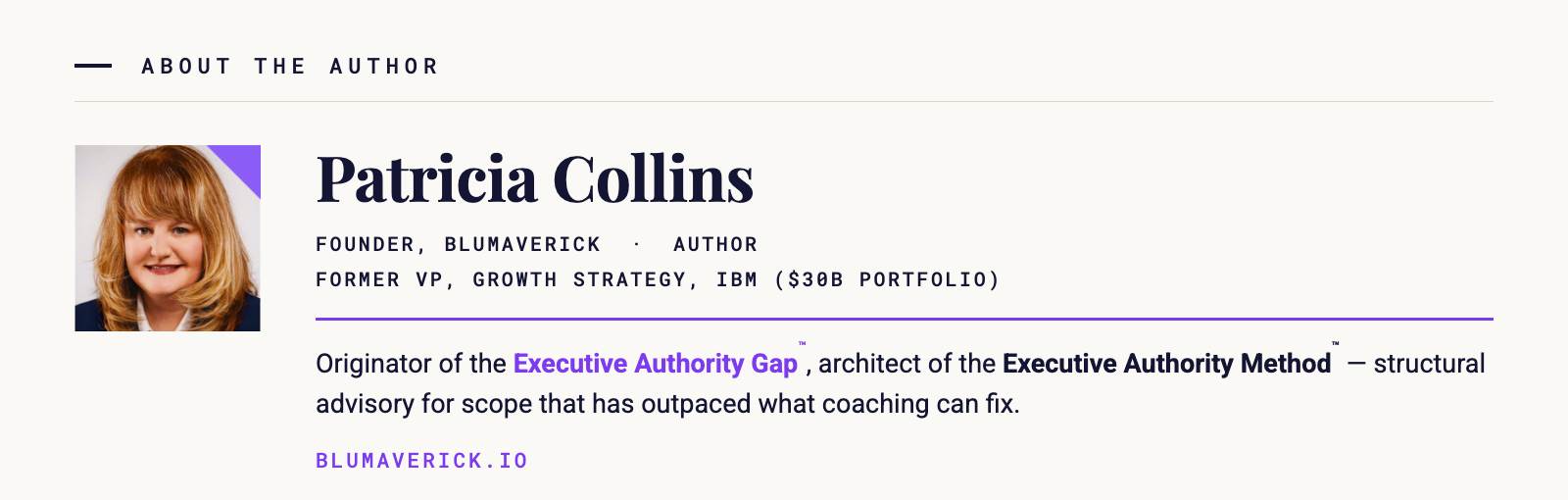
ABOUT THE AUTHOR: PATRICIA COLLINS
Power moves that skip the org chart.
Continue exploring executive authority, structural diagnosis, and the moves that create momentum beyond formal title.
View more Sideways articles →