
You're Not Too Valuable to Promote. You're Too Cheap to Replace.
THE PRICE OF BEING INDISPENSABLE. 3 IN 4 MANAGERS ADMIT IT
3 in 4 managers admit they talk good people out of moving, according to new research in the American Economic Review. "You're too valuable to move" sounds like praise. It is usually a price tag. Here is why, and how to make your role official without going around your boss.

FIG. 01 — THE ROLE GREW. THE PRICE DIDN'T.
"You're too valuable to move right now."
If you run Marketing, GTM or RevOps and you're carrying a bigger role than your title, you've probably heard it. Maybe it came with a smile. Maybe it came with a promise to revisit after the next quarter, the next launch, the next reorg. Either way, you heard it as a compliment. You were meant to.
Here is the contrarian read. You're not too valuable to promote. You're too cheap to replace.
You are carrying a bigger role than your title says. The company is getting that role at your current title's pay. Moving you up means paying for it. Moving you out means finding someone who can do what you do, at a market price, and waiting a year while they learn it. Keeping you exactly where you are costs nothing extra. That is the math behind "too valuable."
Think of a house someone bought ten years ago. It's worth twice the price now. The owner will never sell it, because they could never buy it again at today's price.
What the research found
In August 2026, the American Economic Review published a study by the economist Ingrid Haegele on what economists call talent hoarding. It followed more than 30,000 white-collar and management employees at a large European manufacturer.
The exact question asked managers how often they need to dissuade a team member from exploring opportunities in another department because of immediate team needs or performance goals. 75% said at least sometimes. Nearly half said the risk of losing people was a reason not to invest in their development.
It showed up in the numbers too. Hoarding was more common where managers had more reason to do it: pay tied to their team's results, bigger teams, and strong people that others could see. Hoarding also showed up in how managers scored their own people's readiness for bigger roles.
The sharpest finding came from moments when a manager rotated to a new role and the reason to hold people back went away. The people who had reported to that manager applied for internal roles 78% more often.
Read that from your seat. Most people only move once their boss leaves.
Why your boss is the gate
Your boss is usually the person who rates you, speaks for you in the talent review, and loses the most if you leave the team. None of that requires a bad boss. It requires a boss who is measured on the team's results and has one person carrying more than the title says.
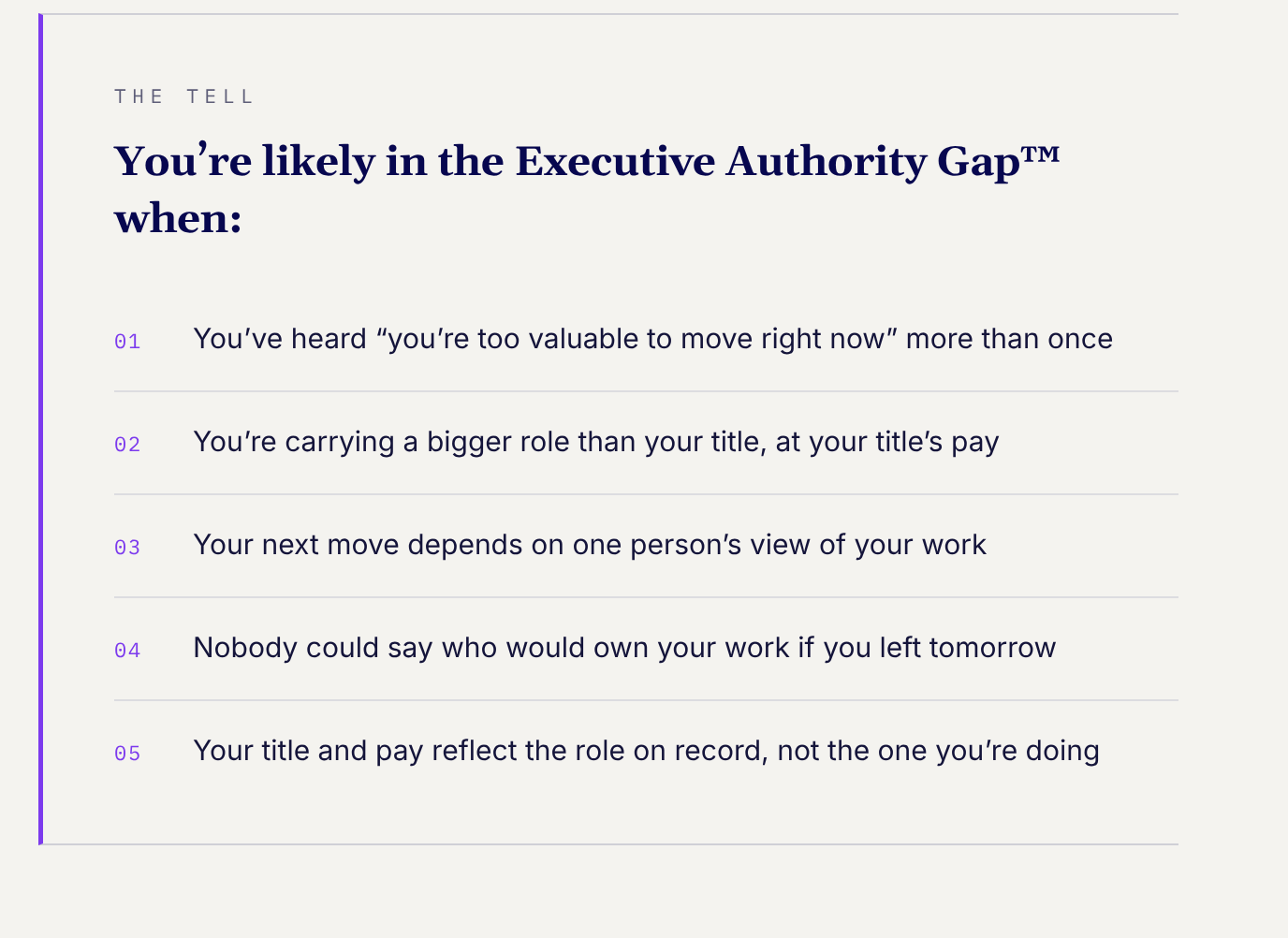
That is responsibility without authority, with a gatekeeper attached. Blumaverick names it the Executive Authority Gap™: you carry the role, while the title, the authority and the pay stay one level down.
Your name is on it. Your signature isn't. Nobody funded the second role.
The two doors everyone sees
Most people in this position think they have two options.
Stay, and keep doing the bigger role at the smaller title, on someone else's timeline.
Or go around the boss: apply for the internal opening, take the meeting with the other department, ask the skip-level for a move. Even when it works, it can read as disloyal. The story becomes that you went over your boss's head, and that story follows you into the next role. Most people sense this and don't apply. That is exactly what the study measured: the applications that never happened.
Both doors cost you. One costs you the role. The other can cost you the relationship you'll need in the room.
The third door
There is a third option, and it doesn't require your boss to leave or you to go around them.
Make the role you're already doing official, where you are, with your boss in the partnership rather than in the way.
It sounds like the same request as a promotion. It isn't. A promotion asks your boss to give something up. Making the role official asks them to fix something the business already relies on. Those are different conversations, and they tend to get different answers.
It also matters who can see the role. Haegele found hoarding inside managers' own ratings. As long as your boss is the only person who knows what you really carry, your boss's rating is the whole story.
A documented role does not guarantee the promotion. It removes the easiest way to deny it.
What this costs if nothing changes
There is a name for what you pay meanwhile: the invisible executive tax. You do the senior work at the junior price, and every raise is calculated on the role on your record rather than the one you're doing.
The business pays too. A company that depends on one person operating above their title, with nothing documented, has a single point of failure it cannot see. When that person finally leaves, the knowledge goes with them.
I held four roles that didn't exist until the company built them around work I was already doing. The work came first every time. The structure followed only once I made the case for it.
Where to start
List the parts of your role that the business now depends on and that no one formally assigned to you. Next to each one, note who would own it if you left tomorrow.
The hard part is everything after the list: what to ask for first, how to raise it, and when, before the 2027 plan closes. Get the order wrong and the request sounds like a threat to leave. That sequencing is executive advisory work, and it is where the Executive Authority Method™ begins: formalizing the role you are operating at, the authority and the comp to match what you already carry.

Patricia Collins, Founder of Blumaverick and former IBM VP • Tech CMO
Power moves that skip the org chart.
Continue exploring executive authority, structural diagnosis, and the moves that create momentum beyond formal title.
View more Sideways articles →