
Why High-Performing Executives Become Organizational Shock Absorbers
If you run RevOps, you own the stack, the number, and every AI system feeding it — and everyone assumes that because you have the title, you have the control. That assumption is the quiet fiction this piece is about.
Your company found a way to keep running while it's structurally broken. If you run RevOps, the mechanism is you.
Every function's mess eventually flows to the one seat wired into all of them.
Sales doesn't update the CRM — you own "the data problem."
Marketing stands up its own AI tool — you inherit the reconciliation.
Finance reworks the model mid-quarter — you rebuild the reporting.
None of it started with you. All of it is now yours to absorb, because you're the most capable operator standing closest to the break.
That's the organizational shock absorber. From the inside it feels like being indispensable. It's actually the company avoiding a redesign by routing the load through one person.
The quiet fiction
At your altitude, authority is assumed. You have the title, so surely you have the control. You don't. You own the go-to-market stack — every tool, every AI system, the number they all feed. You made the architectural calls. You're accountable for what the whole apparatus produces. And you report to a CRO who can't audit any of it.
You own the outcome. You were never given the authority to govern the inputs. That's responsibility without authority — and at the executive level it has a name: the Executive Authority Gap™.
That isn't a workload problem, and it isn't a performance problem. This is not a performance problem. It is an authority problem. The market calls the visible version a "mid-career stall." One level up, near the top, it's quieter and harder to name — executive career derailment. The work moved up. The authority didn't.
Harvard just published the canary
Here's how you know this is structural and not personal: the layer below you was just studied, and the findings are ugly.
In June 2026, HBR researchers (Shin and Sucher) followed the middle manager through AI adoption at two consulting firms. Managers are now told to validate every AI output, coach their teams through it, and hold the quality line — with no change to their formal mandate. Gallup's data puts that same group's engagement at the steepest drop of any layer in the org.
But managers are the documented version. The studied one.
The layer nobody is studying is the one above them — the operator who owns the entire system the manager is drowning inside. If you run RevOps, that's you. You architected the stack. You're accountable for what it produces. You govern none of the inputs. The manager's overload is your gap, one rung down, with a research paper attached. Yours doesn't have the paper yet.
It has a name
Accountable for what the AI produces, without the authority to govern it — that's the AI Authority Gap™, the sharpest, fastest-moving form of the Executive Authority Gap™. and RevOps is the most exposed seat in go-to-market right now, because RevOps is where every GTM-AI system converges on one accountable name.
This is why the board conversation changed this year — from "what's our AI strategy" to "who owns the decisions AI is making here." Naming an accountable owner without moving the authority to govern doesn't close the gap. It just writes the shock absorber's name on the org chart and calls it governance.
What it costs you, unnamed
Your comp tracks the title, not the system you run — and merit cycles never close a structural gap, because the gap lives inside the job, not beside it.
Your next move stalls, because "you're already operating at that level" stops being praise and becomes the reason not to promote you.
When the AI ships something wrong, your name is on it — for a decision you were never authorized to make.
Recognition deferred is compensation saved. The organization depends on the work before it recognizes the role.
The Good News? There is a way to redesign your responsibility and authority so your comp, title and perception align.
See it: the Absorption Audit
Five minutes, one page.
List the last ten things that landed on you and consumed real time — escalations, fixes, fires, decisions.
For each, answer one question: did I create this, or did I absorb it from a gap somewhere else?
Mark each C (created) or A (absorbed).
Count the A's. That number isn't how hard you work. It's how much structural failure the company is routing through a single operator — and how much of your capacity is spent compensating for a design nobody has fixed.
The A's aren't your job. They're the org's unassigned work, wearing your name.
What closes it
Not resilience, and not absorbing the gaps more gracefully — that just proves you'll keep holding them. Support softens the load. Structure removes it. Training works on the person; the fix here works on the structure around the person.
The Executive Authority Method™ redesigns the structure formally — decision rights defined, mandate matched to what you actually run, recognition and comp calibrated to it — so your title and pay have to catch up to the system you already own. Authority that isn't written down doesn't survive the next reorg. Authority that is, does.
The shock absorber kept the company running while it stayed broken. The Good News? Its fixable. The work now is getting the structure fixed — so being the most capable operator in the building stops being the reason you carry what no one else will.
One move this week: take one thing you're accountable for — ideally an AI system or the number — and get the decision right for formalized with your skip-level. One decision. Documented. Not a comp negotiation — a structural observation. That single line does more for your next title than a year of stretch assignments.
Save this before your next steering meeting — it's the five-question audit and the one move, in one place.
Close it
Naming the gap is step one. Closing it is structural work, and it has a method.
Begin with the 60-second Executive Authority Gap Checklist to see where your accountability has outrun your authority.
No Sign Up. No Obligation.
→ See how the Executive Authority Method™ works.
➕ Follow Patricia Collins for executive insights or advice.
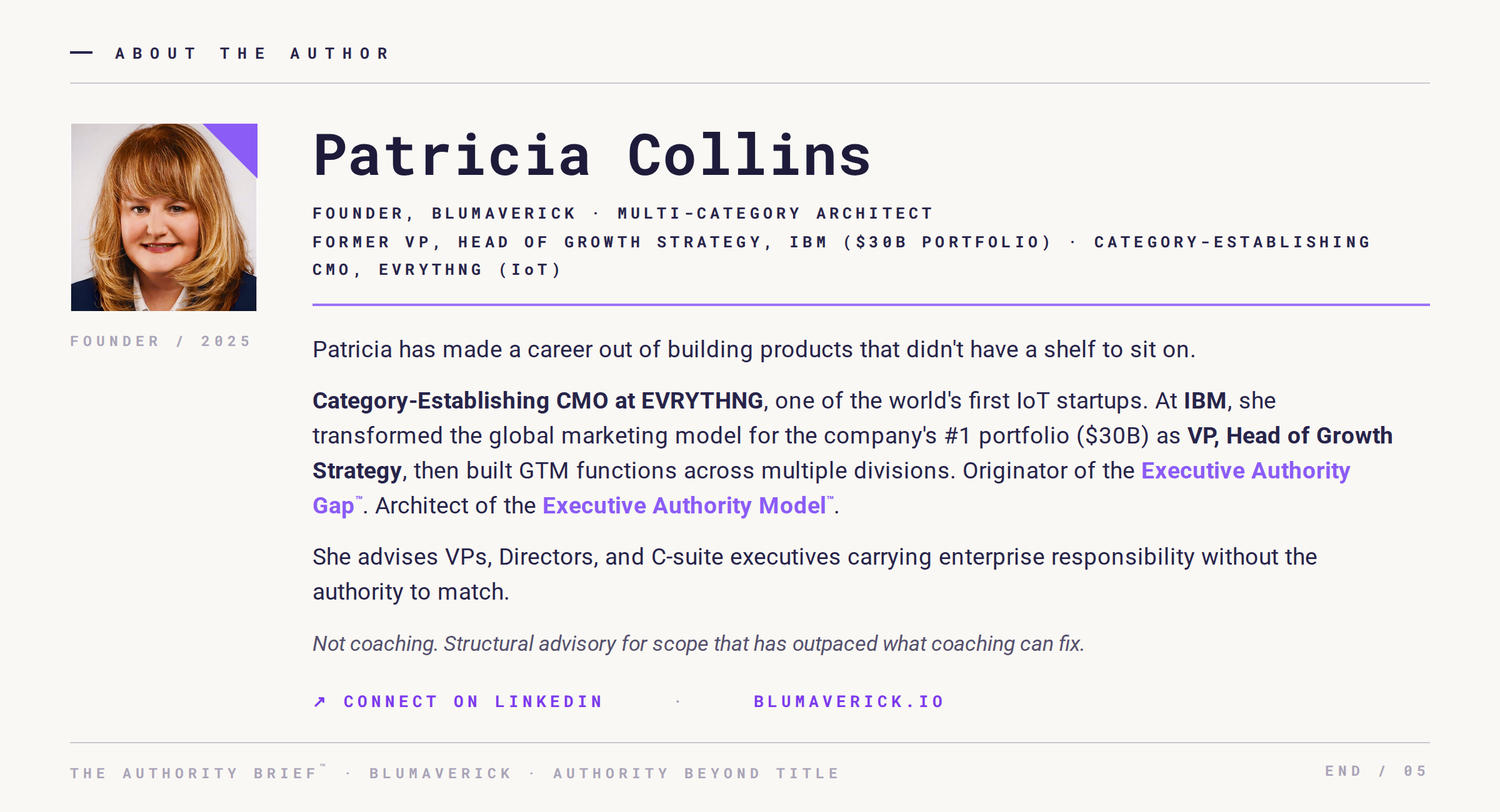
Patricia Collins • Blumaverick, Founder • Author
Power moves that skip the org chart.
Continue exploring executive authority, structural diagnosis, and the moves that create momentum beyond formal title.
View more Sideways articles →